
last updated on 6 August 2026
A neurosurgeon’s perspective on navigating the complexities of DBS surgery — and what patients must ask before choosing where to have it done.
Dr. Paresh Doshi | Director of Stereotactic and Functional Neurosurgery and Director of Neurosurgery, , Jaslok Hospital, Mumbai
Risks in DBS Surgery is a question that arises at every paitents minds but they need to understand not all DBS centres are equal. The difference between a centre with 20 cases and one with 500 can be the difference between an excellent outcome and a preventable complication. Dr Paresh Doshi was the first in India to perform DBS Surgery in 1998. And here are few questions that he suggest every paitent should ask Before you commit, ask these questions:
Research and clinical data consistently show that a minimum of 200 DBS procedures is required before a surgical team achieves the level of confidence, technical refinement, and complication-management capability that defines genuine expertise. Fewer than 200 cases means the team is still on the learning curve — and that learning happens at the patient’s expense.
Dividing cases across multiple hospitals or operating rooms disrupts the consistency of the entire care ecosystem — from theatre setup and nursing protocols to intraoperative neurophysiology and post-operative programming. Outcomes are measurably better when every step of the DBS journey happens under one roof, with the same team, in the same environment.
State-of-the-art stereotactic frames, intraoperative microelectrode recording, real-time imaging integration, and specialised programming hardware are not optional extras — they are fundamental to safe, accurate electrode placement. Ask specifically whether the centre has its own equipment or relies on borrowed or shared resources.
Transparent, published data on surgical complications bifurcate the Risks in DBS Surgery — including hardware failures, infections, and neurological events — is the hallmark of a mature, accountable programme. Ask the surgeon to share peer-reviewed data from their own practice, not general statistics from the literature. Centres that do not publish or audit their outcomes cannot demonstrate improvement over time.
DBS is not a surgical procedure alone. Long-term success depends on expert programming, timely troubleshooting of device issues, and coordinated neurological follow-up. A centre without an integrated multidisciplinary team will leave patients with implanted devices but inadequate long-term support.
DBS surgery is a life-changing procedure. The centre you choose should be able to answer every one of these questions with documented, verifiable evidence. If they cannot — that itself is your answer.
Patients often ask if DBS surgery is effective? So the answer is yes: Deep Brain Stimulation (DBS) has transformed the management of movement disorders over the past three decades. For patients with Parkinson’s disease, essential tremor, dystonia, and an expanding range of neurological and psychiatric conditions, DBS offers what medications alone cannot: sustained, adjustable, and often dramatic relief from debilitating symptoms. At Jaslok Hospital in Mumbai, our programme has been at the forefront of DBS surgery in India — but with that privilege comes an obligation to be unflinchingly honest about the Risks in DBS Surgery, the complications that can occur, and what we have learned from over two decades of performing these procedures.
DBS involves implanting thin electrode leads deep within specific nuclei of the brain, connected via subcutaneous extensions to a pulse generator placed beneath the skin of the chest. It is elegant in concept, extraordinarily precise in execution, and — like all neurosurgical procedures — carries risks that patients and families deserve to understand fully before they consent to surgery.
Surgical complications include haemorrhage (bleeding within the brain), stroke, infection at the surgical site or within the cranium, seizures, confusion, and anaesthetic-related events. The most feared is intracranial haemorrhage — even a small bleed along the electrode trajectory can cause permanent neurological deficit. Careful patient selection, meticulous surgical technique, and rigorous control of blood pressure during the procedure are the principal safeguards.
Hardware complications are a distinct and clinically significant category that are under-appreciated by many patients. These include lead migration (the electrode shifting position after implantation), lead fractures, extension wire breaks, erosion of hardware through the skin, infection requiring partial or complete device explantation, pulse generator malfunction, and connector failures. Hardware complications often require reoperation — a second surgical procedure with its own attendant risks — and can be profoundly distressing for patients who have already endured one surgery.
DBS cases analysed in our Stereotactic Biopsy & DBS publication
Hardware complication cases reviewed in Neuromodulation journal article
Cases required to reach true surgical confidence and low complication rates
At Jaslok Hospital, we have not merely performed DBS surgery — we have systematically studied and reported our outcomes, because transparency in medicine is not optional. Two publications from our programme are particularly relevant to the question of surgical and hardware risk.
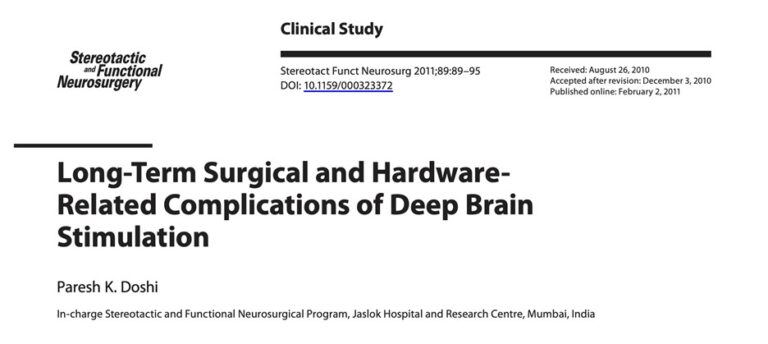
Published in our Stereotactic Biopsy and DBS series, this study examined hardware complications across 150 consecutive DBS cases performed at our centre. It provided a detailed accounting of lead migrations, extension fractures, skin erosions, and infections — along with the surgical strategies employed to manage and prevent them. Critically, the data allowed us to identify patterns that were modifiable through technique refinement and device selection.
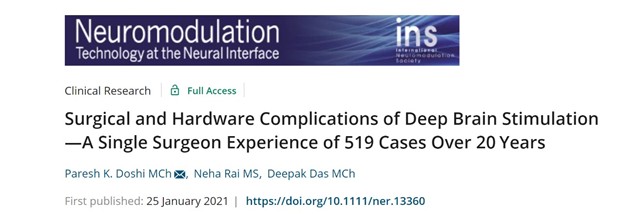
A subsequent publication in the Neuromodulation journal expanded this analysis to 519 cases, making it one of the largest single-centre hardware complication series in the published literature. This study captured the evolution of our complication profile over time, revealing a consistent and statistically meaningful reduction in hardware-related events as our caseload grew — a finding with direct implications for where patients should choose to have their surgery.
Together, these two publications represent one of the most comprehensive accounts of hardware complication management in DBS surgery from a single programme anywhere in South Asia. They are not merely academic exercises — they are the evidence base upon which our current practice has been refined.
Reducing the Risks in DBS Surgery complications is not a single intervention — it is the cumulative product of multiple carefully orchestrated elements, each of which must function with the same precision as the surgery itself.
Patient selection is the first line of defence. Not every patient who wants DBS surgery should have DBS surgery, and not every patient who would benefit from DBS will benefit equally from it at any given point in their disease progression. Rigorous pre-operative evaluation — including detailed neuropsychological assessment, neuroimaging review, and an honest conversation about realistic expectations — is the foundation upon which all subsequent decision-making rests.
Surgical precision and anatomical targeting have been transformed by advances in imaging and intraoperative neuronavigation. At Jaslok Hospital, we combine high-resolution MRI-based target planning with microelectrode recording during surgery — a technique that allows us to confirm the precise location of the electrode within the target nucleus, in real time, through the patient’s own neural signals. This level of anatomical confirmation is not standard at all centres, and its absence is associated with higher rates of lead malposition.
Hardware selection and implantation technique matter profoundly. The routing of extension wires, the depth of subcutaneous tunnelling, the method of anchoring leads at the skull, and the placement of the pulse generator are each individually linked to specific hardware complication types. Our 519-case series directly informed revisions to each of these technical steps, producing measurable reductions in extension fractures and skin erosions.
Infection prevention protocols are non-negotiable. Infection is the complication that most frequently necessitates device explantation, and device explantation is the outcome most devastating to a patient who has waited, hoped, and undergone surgery. Laminar flow theatres, antibiotic-impregnated irrigants, meticulous wound closure, and extended prophylactic antibiotic regimens are all components of our current protocol — each adopted in response to data from our own outcomes analysis.
Post-operative programming and follow-up contribute to complication mitigation in ways that are easily overlooked. Suboptimal stimulation programming can cause patients to inadequately benefit from surgery, leading to unnecessary device adjustments, overuse of stimulation amplitudes, and battery depletion. Expert programming is not a supplementary service — it is integral to the safety of the device over its lifetime.
The learning curve in DBS surgery is real, documented, and clinically significant.
Analysis of our own outcomes data from Jaslok Hospital demonstrates what the surgical literature broadly corroborates: hardware complication rates, surgical adverse events, and the precision of targeting all improve substantially after approximately 200 procedures — and continue to improve, though more gradually, thereafter.
In our practice at Jaslok Hospital, the risk reduction that occurred after crossing the 200-case threshold was not subtle or difficult to measure. It was evident in the reduction in lead revisions, in the near-elimination of extension wire fractures, in the declining rate of wound-related complications, and in the increasing confidence with which our team handled the unexpected intraoperative findings that every neurosurgeon who performs enough DBS eventually encounters.
What changes after 200 cases? The answer is: almost everything, in small but cumulatively decisive ways. The surgical approach becomes more efficient. The team’s anticipation of potential problems becomes sharper. The choice of anaesthetic technique, patient positioning, and intraoperative monitoring becomes more precisely calibrated to the individual. The handling of hardware — the routing of leads, the tension on extension connectors, the placement of the generator pocket — becomes second nature rather than effortful deliberation.
Equally important is what happens to the team around the surgeon. The neurophysiologist who has participated in 200 DBS recordings knows the difference between target confirmation and a borderline trace. The scrub nurse who has handled the hardware on 200 cases knows instinctively how to protect delicate electrode contacts during implantation. The neurologist who has programmed 200 patients knows how to distinguish a suboptimally positioned lead from a suboptimally programmed one. This collective expertise — accumulated through repetition at a single centre — is not transferable, and it is not available to programmes that distribute their cases across multiple institutions or that have not yet reached a meaningful caseload threshold.
The implication for patients is direct and important: when a centre performs DBS surgery infrequently — say, 20 or 30 cases a year across a large number of surgeons — no individual surgeon, and no single team, accumulates the experience needed to push complication rates to their minimum. High-volume, single-centre programmes are not a luxury preference. They are a structural requirement for safe DBS surgery.
The evolution of DBS technology continues to offer new tools for complication reduction. Directional leads that steer current away from unintended anatomical structures, MRI-conditional devices that allow post-operative imaging without device removal, closed-loop systems that automatically adjust stimulation parameters in response to the brain’s own signals, and improved anchoring systems for hardware fixation — all of these represent genuine advances. At Jaslok Hospital, our ability to adopt and critically evaluate new technology safely rests directly on the experience base our team has built through more than two decades of dedicated practice.
But technology alone does not make surgery safe. It is the surgeon’s hands, the team’s cohesion, the programme’s intellectual honesty about its own outcomes, and the institution’s commitment to continuous improvement that ultimately determine what a patient’s experience of DBS surgery will be. Our publications exist precisely to hold ourselves accountable to these standards — and to make the evidence available to patients and colleagues worldwide.
Deep Brain Stimulation, performed well, is among the most powerful interventions available to patients with movement disorders. Performed poorly, or in an environment where the institutional and human foundations for safety have not yet been established, it carries risks that are preventable. The difference between these two scenarios is not a matter of surgical intent — every surgeon who offers DBS intends to do their best. The difference is experience, volume, infrastructure, team cohesion, and the discipline of honest self-assessment over hundreds of cases.
At Jaslok Hospital, under the leadership of Dr. Paresh Doshi, our programme has invested two decades in building precisely this foundation. The checklist at the opening of this article is not designed to be confrontational — it is designed to give patients the language to have an informed conversation with any centre they are considering. The answers they receive will tell them everything they need to know.
About this article Dr. Paresh Doshi is a Director of Stereotactic and Functional Neurosurgery and Director of Neurosurgery at Jaslok Hospital, Mumbai, with one of the largest DBS case volumes in Asia. His published research includes peer-reviewed studies on hardware complications in DBS surgery across 150 and 519-case series. This article is intended for patient education and does not constitute individual medical advice. |
1. Is DBS surgery safe for patients with Parkinson’s disease?
Yes. DBS is an established surgical treatment for appropriately selected patients with Parkinson’s disease. Like any brain surgery, it carries potential risks such as bleeding, infection, seizures and temporary confusion. A thorough pre-surgical evaluation helps determine whether the potential benefits outweigh the risks for an individual patient.
2. What are the risks or side effects of DBS surgery?
Possible risks include infection, bleeding, seizures and temporary pain or swelling after surgery. Stimulation-related effects can include speech, balance, mood or coordination changes. Many stimulation-related side effects can be managed by adjusting the DBS settings.
Dr. Manish Baldia is a neurosurgeon trained under Dr. Paresh Doshi and works in Deep Brain Stimulation (DBS). He has done fewer cases so far, so his experience is still growing compared to Dr. Doshi’s extensive experience.
WhatsApp us