
Understanding the options, benefits, limitations and long-term questions
Medically reviewed by Dr. Paresh K. Doshi, MCh Director, Stereotactic &
Functional Neurosurgery, Jaslok Hospital & Research Centre, Mumbai
Last updated: October 6, 2026
The key question is not only what works today. Because Parkinson’s disease is progressive and often becomes bilateral, patients should also ask: What happens if my symptoms change in the future?
Key takeaways
Because Parkinson’s commonly becomes bilateral, the long-term implications of unilateral versus bilateral lesioning deserve careful discussion.
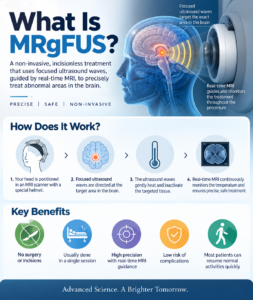
MRgFUS (MRI-guided focused ultrasound) and deep brain stimulation (DBS) are both used in selected patients with Parkinson’s disease, but they work in fundamentally different ways. MRgFUS creates a permanent lesion in a targeted brain circuit. DBS uses implanted electrodes to deliver electrical stimulation that can be adjusted over time.
The choice should therefore go beyond the question of which procedure is less invasive. It should consider which symptoms need treatment, whether they are on one side or both, how Parkinson’s disease may evolve, and whether the treatment can be adapted if the clinical picture changes.
MRgFUS stands for Magnetic Resonance-guided Focused Ultrasound. Multiple beams of ultrasound energy are focused on a selected target within the brain. MRI provides anatomical guidance and MRI thermometry allows the treatment team to monitor temperature during treatment.
Unlike conventional stereotactic surgery, MRgFUS does not require a scalp incision, burr hole or implanted electrode. Patients remain awake, allowing the team to assess movement, tremor, speech and other functions while treatment is delivered.
Important Pre-operative Requirements: To ensure the ultrasound waves penetrate effectively and safely, patients must undergo a pre-operative CT scan to calculate their Skull Density Ratio (SDR). If the skull absorbs too much energy, the procedure cannot be performed. Additionally, the procedure requires complete head shaving to prevent hair from trapping air bubbles that can scatter the ultrasound waves.
The important point is that the therapeutic effect is produced by creating a permanent lesion in the targeted tissue.
There is no scalp incision or implanted hardware, so “incisionless” is an accurate description. However, “non-invasive” can be misunderstood if it suggests that the brain is not permanently altered. MRgFUS is an ablative procedure: its purpose is to create a permanent lesion in a precisely selected brain target.
In the randomized clinical trial of MRgFUS thalamotomy for medicationrefractory, tremor-dominant Parkinson’s disease, median treated-hand tremor scores improved by 62% at three months after focused ultrasound, compared with 22% after sham treatment (Bond et al., JAMA Neurology, 2017). The study was small and focused primarily on tremor rather than the full spectrum of Parkinson’s disease symptoms.
This distinction matters. A treatment that reduces tremor does not necessarily treat rigidity, bradykinesia, motor fluctuations, dyskinesia, gait problems, freezing of gait or non-motor symptoms.
No. MRgFUS is a symptomatic treatment. Parkinson’s disease itself continues to progress after treatment. The dominant problem at one stage of the disease may not be the dominant problem several years later. Precisely for these reasons DBS scores over MRgFUS
MRgFUS avoids implanted hardware, but it is not risk-free. Reported adverse effects include headache, dizziness, sensory changes, imbalance and gait
disturbance; some effects may persist. The fundamental limitation of lesioning is that the lesion cannot subsequently be turned down, reprogrammed or switched off if the clinical situation changes. The risks of haemorrhage and irreversible dysarthria (speech disturbances) and gait (walking) problems are real and if they occur they are irreversible. In the recently approved PTT target for Bilateral Parkinson’s disease the risks of these complications have been reported up to 25%!! DOI: 10.1016/S1474-4422(26)00142
This is the most important long-term question for a patient with Parkinson’s disease. Parkinson’s is a progressive neurological disorder. A patient may initially have predominantly one-sided tremor, while later developing symptoms on the other side, gait impairment, freezing, dyskinesia, rigidity or motor fluctuations.
With MRgFUS, the lesion created at the time of treatment remains where it was created. With DBS, stimulation parameters can be changed as symptoms and side effects change.
For example, a patient may initially need stimulation primarily for tremor and rigidity. If gait impairment or freezing of gait becomes a major problem later, the DBS programming strategy can be reconsidered. In selected patients, different stimulation frequencies and other programming strategies may be explored depending on the electrode location, symptoms and individual response.
The practical difference: DBS does not stop Parkinson’s from progressing, but it gives the treating team a platform that can be reprogrammed as the disease evolves. The MRgFUS lesion itself cannot be reprogrammed.
Many patients eventually have symptoms affecting both sides. This makes the question of bilateral treatment particularly important.
Staged bilateral MRgFUS pallidothalamic tractotomy is now authorized in selected patients, but bilateral lesioning deserves careful counselling because the second lesion is also permanent. The 2026 prospective multicentre trial reported a greater burden of persistent speech, gait and balance complications after bilateral treatment than after unilateral treatment (Dalvi et al., Lancet Neurology, 2026).
DBS has a long-established role in bilateral treatment. Importantly, stimulation can be adjusted on each side if benefit or side effects change.
Previous MRgFUS does not necessarily eliminate DBS as a later option. Case reports and series have described patients undergoing DBS after previous focused-ultrasound treatment. However, this should not be interpreted as making the two procedures interchangeable or as meaning that MRgFUS should routinely be used as a first step before DBS.
Feature | MRgFUS | DBS |
How it works | Creates a permanent lesion in a selected brain target | Implanted electrode delivers adjustable electrical stimulation |
Incision/ implant | No scalp incision or implanted hardware | Stereotactic surgery and implanted hardware |
Reversibility | The lesion itself is permanent | Stimulation can be reduced, changed or switched off |
Adjustability over time | The lesion cannot be reprogrammed | Programming can be changed as symptoms evolve |
Bilateral treatment | Possible in selected patients; bilateral lesion risks | Established bilateral therapy with adjustable stimulation |
Long-term strategy | Best suited to a carefully selected symptom and target | Provides an adjustable treatment platform for an evolving disease |
Hardware maintenance | No implanted device | Battery/generator management and programming follow-up |
Best-suited candidate profile | Predominantly unilateral, medication-refractory tremor; strong preference to avoid implants | Bilateral symptoms, motor fluctuations, dyskinesia, or a need for adjustable, longterm therapy |
A note about the history of lesioning and DBS
The development of DBS in the late 1980s and 1990s changed functional neurosurgery because stimulation could be adjusted, reduced or switched off and could be used bilaterally. These advantages contributed to the gradual replacement of many traditional lesioning procedures by DBS for Parkinson’s disease. This history is relevant when considering the different long-term philosophies of lesioning and neuromodulation today. At Jaslok Hospital & Research Centre, our functional neurosurgery team has over 30 years of published, extensive experience spanning both advanced lesioning techniques and Deep Brain Stimulation, ensuring that treatment recommendations are grounded in decades of long-term patient outcomes.
Is MRgFUS truly non-invasive?
It is non-incisional, but it is not non-destructive. There is no incision into the skull, but focused ultrasound intentionally creates a permanent lesion inside the brain. This is why the distinction between MRgFUS and DBS is clinically important.
Can MRgFUS be reversed if I do not like the result?
The lesion itself cannot be reversed or switched off. Some consequences may be managed medically or with other treatment, but the original lesion remains.
Can DBS be turned off if there is a side effect?
The electrical stimulation can generally be reduced, changed or switched off. This does not mean DBS surgery has no permanent risks; rather, the stimulation component is adjustable after implantation.
What happens if my Parkinson’s disease progresses after MRgFUS? The disease can continue to evolve, and the original lesion cannot be reprogrammed. New symptoms may therefore require medication, rehabilitation or another treatment strategy. In selected patients, DBS may still be considered later.
What happens if I develop gait or freezing problems after DBS?
The DBS system can be reassessed and reprogrammed. Depending on the individual patient, lead location and clinical circumstances, different contacts, frequencies and other stimulation parameters may be considered.
Programming is individualized and does not guarantee improvement in gait or freezing.
Can MRgFUS treat both sides of Parkinson’s disease?
Staged bilateral treatment is possible in selected patients, but bilateral lesioning deserves particular caution because both lesions are permanent. The additional benefit and the additional risk must be considered individually.
Does MRgFUS treat all Parkinson’s symptoms?
No. MRgFUS is target- and symptom-specific. Improvement in tremor should not be interpreted as treatment of Parkinson’s disease as a whole.
Is MRgFUS safer than DBS because there is no implanted device? The risk profiles are different. MRgFUS avoids implanted hardware but creates a permanent lesion. DBS involves surgery and implanted hardware but provides adjustable stimulation. The appropriate choice depends on the individual patient.
Can I have DBS after MRgFUS?
In selected patients, yes. Previous MRgFUS does not necessarily close the door to later DBS, but the decision requires individualized assessment.
What is the most important question to ask my specialist?
“If my Parkinson’s disease changes over the next five or ten years, how will this treatment allow us to respond?” This question captures the central difference between a permanent lesion and an adjustable neuromodulation strategy.
WhatsApp us