
last updated on 6 August 2026
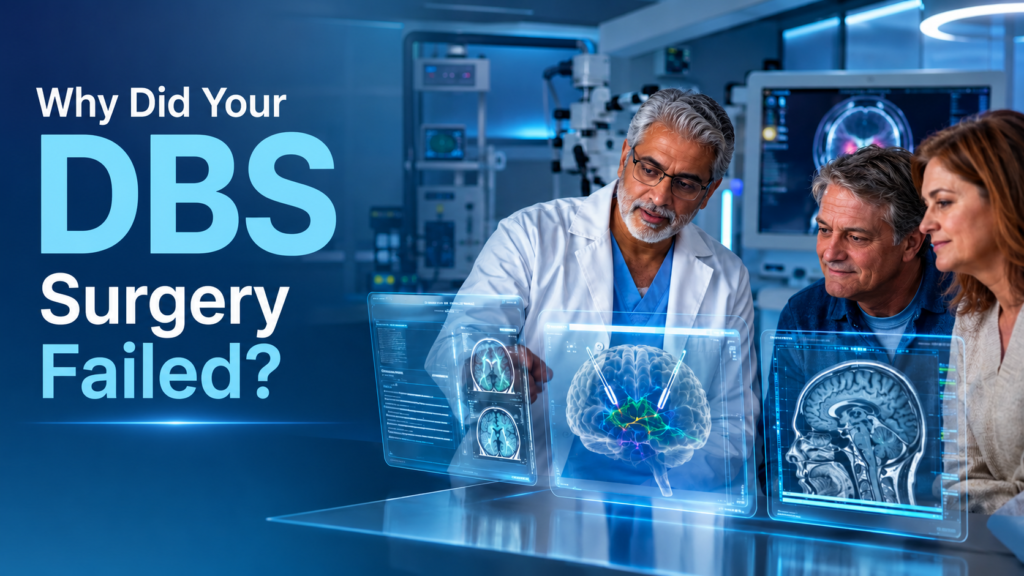
If you are reading this, you or someone you love has been through Deep Brain Stimulation surgery and the outcome has not been what you hoped for. You may be living with symptoms that have not improved, or that improved initially and have since returned. You may have been through multiple programming sessions with little change. You may have been told that nothing more can be done.
We want to say this to you directly: in most cases, something more can be done.
Prof. Dr. Paresh K. Doshi and his team at Jaslok Hospital have evaluated more than 300 patients who came to us after DBS surgery performed elsewhere did not deliver the expected benefit. Of these 300+ cases, we replaced the electrodes in only 3 to 4 patients. In the remaining cases — through careful re-evaluation, advanced reprogramming, and multidisciplinary support — we were able to achieve meaningful improvement without further surgery.
To put that in perspective: fewer than 1% of patients who have undergone DBS at Jaslok over 28 years have needed to seek revision care elsewhere. That comparison is not a boast. It is an invitation to come and find out what is possible.
After 28 years of performing and evaluating DBS surgery, Prof. Dr. Doshi’s answer to the question of why outcomes sometimes fall short is honest and uncomfortable: the therapy, the surgeon, and in some cases the patient’s expectations, all play a role.
Deep Brain Stimulation has been proven effective in Parkinson’s disease with motor fluctuations — this is a bold statement, but it is true and supported by the experience of more than 3,00,000 patients worldwide across different regions and technologies. The therapy itself is not the problem.
This is the most critical variable. DBS is not a procedure that can be learned from a textbook or delivered at adequate quality by a surgeon who performs it infrequently. The questions you should have been able to ask — and should ask now when considering revision care — are these:
Tall claims of experience on the internet are easy to make and difficult for a patient to verify. What you can do is make a simple calculation: annual surgery volume multiplied by years of practice gives you a rough total. At the current state of DBS in India, only three or four centres perform more than 50 DBS surgeries per year. Most centres are significantly below this.
The decision to offer DBS must be made with a long-term view of the patient’s disease — not for a short-term outcome that impresses at the three-month review. Several patients who have come to us with disappointing results were initially well-selected but were not given realistic expectations about what DBS can and cannot do, or about how the disease would evolve after surgery. Others were operated before they were truly ready, or for symptoms that were better addressed with medication adjustments first.
Understanding which of these factors contributed to your situation is the starting point of our evaluation.
When a patient comes to us after an unsatisfactory DBS outcome, we do not start from where the last doctor left off. We start from the beginning.
This multi-step process typically requires a stay of 4 to 7 days in Mumbai for the initial assessment and programming. Thereafter, most patients require 2 to 3 visits in the first year, and an annual visit to maintain stable programming — a significantly lower visit burden than most centres.
Will you replace my DBS electrodes if I come to Jaslok?
We rarely replace electrodes. Of more than 300 patients who came to us with failed or suboptimal DBS outcomes, we replaced electrodes in only 3 to 4 cases. In the rest, our advanced reprogramming protocols and proprietary programming algorithms were sufficient to achieve meaningful improvement — without additional surgery. Electrode replacement is considered only when imaging clearly shows the lead is too far from any target that could yield a therapeutic response.
How long will I need to stay in Mumbai for reprogramming?
Our reprogramming protocol requires an initial stay of 4 to 7 days in Mumbai. During this time, we conduct our full evaluation, establish a programming baseline, and make the first round of adjustments. Once programming is stabilised, most patients need to visit us 2 to 3 times in the first year, and approximately once a year thereafter. This is considerably less frequent than the every 10 to 15 day visits that some patients have experienced at other centres.
Will my medicines continue after DBS reprogramming?
Yes. We use medication and programming as complementary tools, not alternatives. Some symptoms respond more reliably to medication adjustments, others to stimulation changes. Our approach deliberately combines both — which is one of the reasons our outcomes are more durable than programming alone can achieve.
How long will the benefit from reprogramming last?
We will not make you a promise that cannot be kept. Parkinson’s disease continues to progress, and the brain adapts to stimulation over time. What we can say honestly is that we have access to most of the strategies currently available in the world to address these changes, and that 28 years of continuous patient follow-up at our centre gives us earlier visibility into when and how to intervene. Our aim is to give you the longest possible period of stable, good-quality function.
Is it possible that my DBS device is limiting what programming can achieve?
Yes. Some older or basic DBS devices do not support advanced stimulation modes — directional stimulation, multiple independent current control, or adaptive DBS — that may be necessary to achieve the best outcome in a complex case. We assess the device as part of our evaluation and advise you honestly if an upgrade would make a meaningful difference. We do not recommend upgrades unless we believe they will genuinely improve your situation.
My symptoms improved after surgery and then came back. Is that a failure?
Not necessarily. Initial improvement followed by a return of symptoms is one of the most common presentations we see. There are several reasons this can happen — the disease has progressed, the stimulation parameters need updating, the medications need rebalancing, or the patient has developed new non-motor symptoms that are affecting overall quality of life despite adequate motor control. All of these are addressable. The return of symptoms after initial improvement is a signal that the programming needs attention, not that DBS has failed.
If you are not satisfied with your DBS outcome, the first step is a conversation. We will not pressure you into any decision. We will review what has happened, tell you honestly what we think is possible, and give you time to decide.
You can reach us by phone, WhatsApp, or email. If you are coming from outside Mumbai, we can arrange a preliminary remote consultation based on your medical records and imaging before you travel. Book Your Appointment Now
Contact | Details |
Phone / WhatsApp | +91 99309 90777 |
pdoshi@neurologicalsurgery.in | |
Hospital | Jaslok Hospital & Research Centre, 15 Dr G Deshmukh Marg, Pedder Road, Mumbai 400026 |
Remote Consultation | Available for patients outside Mumbai — send records and imaging to the email above |
WhatsApp us