
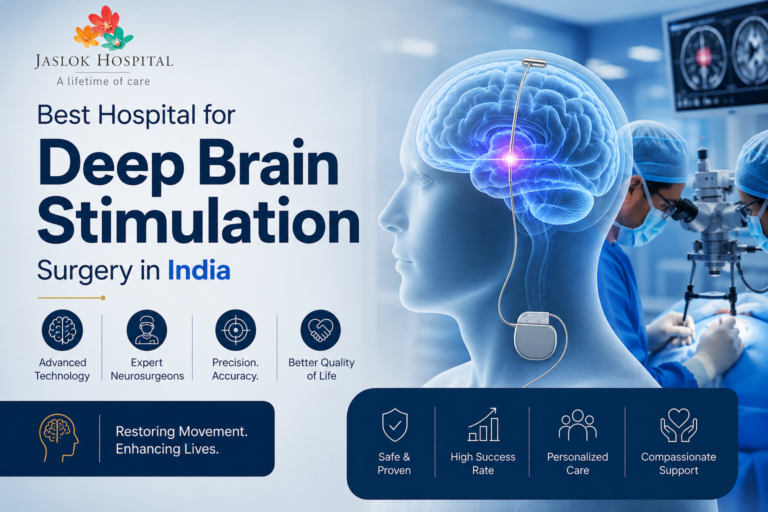
Choosing the right hospital for Deep Brain Stimulation (DBS) surgery in India is an important decision for patients living with Parkinson’s disease, essential tremor, dystonia and other movement disorders.
DBS is a highly specialised form of functional neurosurgery. The outcome depends on much more than the surgical implantation of the device — careful patient selection, accurate target planning, surgical expertise, neurological assessment, programming and long-term follow-up all play an important role.
India has several established hospitals and specialist centres offering DBS surgery. Among them, Jaslok Hospital & Research Centre in Mumbai runs one of the country’s longest-established DBS programmes, dating back to 1998.
There is no single hospital that is universally “the best” for every DBS patient. The right centre depends on the patient’s diagnosis, symptoms, medical history, suitability for surgery and the expertise of the treating team.
When comparing DBS hospitals, patients and families should consider:
A hospital’s overall reputation matters, but the specific track record of its DBS team is what patients should weigh most heavily.
Several major neurological and multispecialty hospitals across India provide DBS services or advanced movement-disorder care. These centres should not be read as a fixed ranking — expertise, technology, team composition and treatment options change over time.
Jaslok’s DBS programme was established in 1998 by Prof. Dr. Paresh K. Doshi and, per the hospital’s current published figures, has since crossed 750 procedures. The programme offers multidisciplinary assessment and functional neurosurgical care for appropriate candidates, supported by dedicated stereotactic infrastructure — stereotactic frames, planning stations, MRI and microelectrode recording equipment.
Apollo Hospitals provides DBS and movement-disorder services at multiple locations. Apollo Chennai announced the clinical activation of India’s first Adaptive Deep Brain Stimulation (aDBS) system in March 2026 for Parkinson’s disease, performed by a multidisciplinary team spanning movement-disorder neurology and functional neurosurgery. However, there is a caveat here. It was not the DBS system (the DBS system was Percept PC, which actually was done for the first time in entire Asia at the Jaslok Hospital and research centre. Apollo’s Mumbai and Navi Mumbai centres also offer DBS-related neurological and neurosurgical services.
Medanta is another major tertiary-care centre providing advanced neurological and neurosurgical treatment, including DBS (“brain pacemaker”) surgery for appropriately selected patients. Patients considering Medanta should evaluate the experience of the specific movement-disorder and functional-neurosurgery team managing their case.
Major academic and tertiary-care institutions in India also provide specialist neurological and neurosurgical services. However, when compared to Private institutes, there is a lack of personalized care, focused approach and in some places adequate infrastructure is also lacking. Besides, the team experience also keeps on fluctuating as the doctors keep on changing. For patients considering DBS, it is important to assess the specific DBS programme and treating team rather than relying solely on institutional reputation.
A programme that has run continuously since 1998 accumulates something a newer centre cannot: long-run follow-up data on how patients do years — not just months — after surgery, and a surgical and programming protocol that has been refined across successive patient cohorts.
Reported figures put the programme’s caseload above 750 DBS procedures. In DBS, experience matters less as a raw number and more as the accumulated judgment behind it — patient selection, target selection, intraoperative decision-making and postoperative programming are all decisions that improve with repetition.
The programme is led by Prof. Dr. Paresh K. Doshi, Director of Stereotactic & Functional Neurosurgery at Jaslok. His official hospital profile lists more than 30 years of experience, with expertise in DBS surgery, stereotactic surgery and surgery for movement disorders including Parkinson’s disease. Not only he has a very large series of surgical experience, it is most diverse, most advanced and technologically ahead of any other centre in India. This is possible because all technologies in the field of DBS, whether they are DBS related devices (implants) or stereotactic frames etc were initially brought in at the Jaslok Hospital.
The programme’s stated equipment includes dedicated stereotactic frames, planning systems, MRI and microelectrode recording capabilities, which support the surgical team in planning and performing DBS procedures accurately.
DBS is not appropriate for every person with Parkinson’s disease or tremor. Jaslok states that patients undergo multidisciplinary assessment — neurological, neuropsychological and surgical review — before DBS is recommended, an important safeguard given that the potential benefits and risks need to be weighed individually.
Prof. Dr. Paresh K. Doshi is Director of Stereotactic & Functional Neurosurgery at Jaslok Hospital & Research Centre, Mumbai. His official hospital profile lists:
DBS is primarily used for selected patients with movement disorders.
DBS may be considered for selected people with Parkinson’s disease when symptoms such as tremor, rigidity or motor fluctuations remain inadequately controlled with medication, or when medication-related complications become difficult to manage. DBS does not cure Parkinson’s disease — it can help control certain symptoms in appropriately selected patients.
DBS can be considered for some patients with severe, disabling tremor that has not responded adequately to medication.
Certain patients with medically refractory dystonia may benefit from DBS.
DBS is also used in selected cases for other neurological or neuropsychiatric conditions. Whether it is appropriate depends on the specific diagnosis and the available clinical evidence.
Deep Brain Stimulation involves implanting one or more thin electrodes into a carefully selected region of the brain. The electrodes are connected to a pulse generator implanted under the skin, which delivers controlled electrical stimulation to the targeted region. The treatment is adjustable — stimulation parameters can be modified over time based on the patient’s symptoms and response.
A comprehensive evaluation is usually performed before surgery. Depending on the patient’s condition, this may include:
The purpose is to determine whether DBS is appropriate and, if so, which treatment strategy may be suitable.
The exact surgical approach varies between patients and centres. In general, DBS treatment involves:
Step 1: Surgical Planning
Brain imaging and other investigations are used to identify the intended target.
Step 2: Electrode Placement
The DBS electrode is carefully positioned within the selected brain target using stereotactic techniques.
Step 3: Pulse Generator Placement
The electrode is connected to a pulse generator implanted beneath the skin.
Step 4: Programming
After surgery, the DBS system is programmed and adjusted according to the patient’s symptoms and response.
Step 5: Long-Term Follow-Up
Regular follow-up is important because stimulation settings and medications may need to be adjusted over time.
Before choosing a hospital, patients should ask the following questions:
1. How experienced is the DBS surgeon?
Ask specifically about experience in functional neurosurgery and DBS, rather than only general neurosurgical experience.
2. How experienced is the neurological team?
DBS requires close collaboration between neurology and neurosurgery.
3. How many DBS procedures has the centre performed?
A hospital should be able to explain its experience with DBS procedures and the conditions it commonly treats.
4. How are patients selected?
A comprehensive assessment is essential because DBS is not appropriate for every patient.
5. What technology is available?
Ask about stereotactic planning, imaging, intraoperative monitoring and other technologies used by the centre.
6. Who will manage DBS programming?
Programming and follow-up are important components of DBS treatment.
7. What happens after surgery?
Ask about long-term follow-up, medication adjustments, programming and management of potential complications.
The cost of DBS surgery in India can vary considerably. Factors that can influence the overall cost include:
Patients should request a detailed treatment estimate from the hospital because the final cost depends on the individual treatment plan and device selected.
DBS is an established surgical treatment, but it is still brain surgery and carries potential risks. Possible complications can include:
The individual risk depends on the patient’s medical condition, diagnosis, surgical target and other factors. A specialist DBS team should explain the potential benefits and risks before surgery.
For appropriately selected patients, DBS can provide significant improvement in certain symptoms. Potential benefits may include:
Results vary between individuals, and DBS should not be presented as a cure for Parkinson’s disease or other progressive neurological disorders.
There is no single hospital that is best for every DBS patient. Jaslok Hospital & Research Centre in Mumbai is one of India’s longest-established DBS centres, with a programme that began in 1998 and has performed more than 750 DBS surgeries to date.
Experience is hard to compare across centres because hospitals report figures differently and case-mix varies. Jaslok’s programme is among the longer-running in the country, with a continuous track record since 1998.
DBS may be considered for carefully selected patients with conditions such as Parkinson’s disease, essential tremor or dystonia when symptoms remain inadequately controlled despite appropriate medical treatment.
No. DBS does not cure Parkinson’s disease. It can help control certain symptoms in appropriately selected patients.
The duration varies according to the surgical approach, patient and technology used. The treating hospital should provide an individualised estimate.
The longevity of the implanted pulse generator depends on the device type, stimulation settings and usage. Some systems require eventual battery replacement, while rechargeable systems can have a longer usable life with periodic charging.
Some appropriately selected Parkinson’s patients may be able to reduce certain medications after DBS, but this varies considerably between individuals. Medication changes should always be guided by the treating neurologist.
No. DBS is suitable only for selected patients following detailed neurological, medical and surgical evaluation.
A second opinion can be useful when considering major neurosurgery, particularly if there is uncertainty about candidacy, expected benefits, treatment target or alternative treatment options.
WhatsApp us