
By Prof. Dr. Paresh Doshi — Director, Stereotactic & Functional Neurosurgery, Jaslok Hospital, Mumbai. Performed India’s first DBS surgery in 1998; 750+ DBS procedures over 30 years.
Short answer: Yes — for appropriately selected patients, DBS surgery is safe. Like any surgery or medical treatment, it carries some risk of side effects and complications. If your doctor hasn’t walked you through those risks in detail, that conversation isn’t finished yet. Below is the same explanation I give my own patients and their families.
As a patient, you can’t eliminate risk — no surgery is risk-free — but you can be well informed and choose a surgeon and a level of risk you’re genuinely comfortable with. That starts with understanding, specifically, what can go wrong.
DBS risk falls into two distinct categories, and it’s worth keeping them separate because they’re managed differently: immediate surgical complications from the operation itself, and delayed side effects that come from stimulation — usually from DBS programming that hasn’t yet been fine-tuned.
Surgical Complications
There are three complications that matter most:
How We Measure and Reduce This Risk at Jaslok Hospital
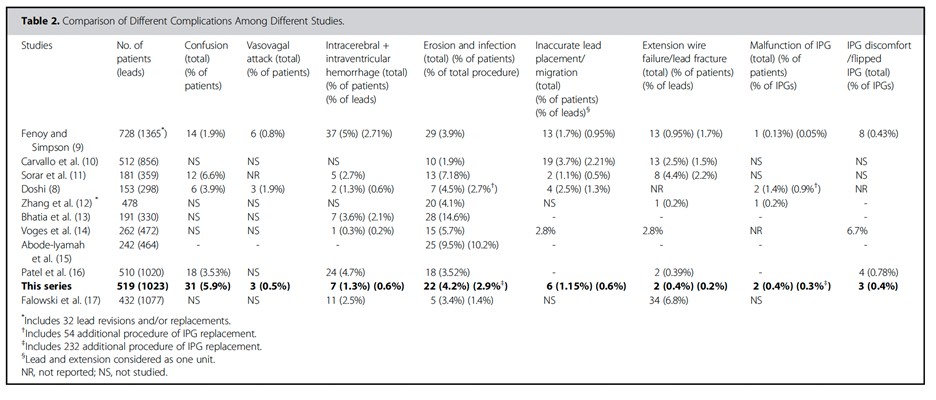
The first step in managing any risk is measuring it honestly and publishing the results — not just making claims. We’ve done this twice, eleven years apart, as our experience grew:
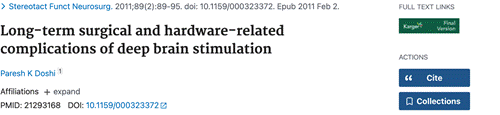
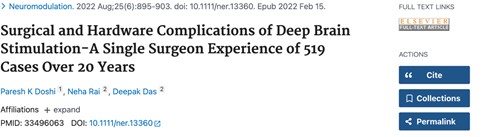
Doshi PK, Rai N, Das D. “Surgical and Hardware Complications of Deep Brain Stimulation — A Single Surgeon Experience of 519 Cases Over 20 Years.” Neuromodulation. 2022;25(6):895–903. doi:10.1111/ner.13360.
That drop is the clearest evidence of what experience actually does to risk: it isn’t a claim, it’s a measured, published result. It’s also why this work gets invited internationally — most recently a lecture on minimizing DBS complications, delivered at Mayo Clinic in June 2026.
The second category of risk has nothing to do with the surgery itself — it comes from how the device is programmed afterward. Stimulation settings that are too aggressive, or not yet correctly tuned, can occasionally produce mood, impulse-control, or personality changes. These are real, they’re published in the medical literature, and knowing about them in advance is part of being properly informed — not a reason to be alarmed.
We’ve published on this transparently, including cases from our own practice:
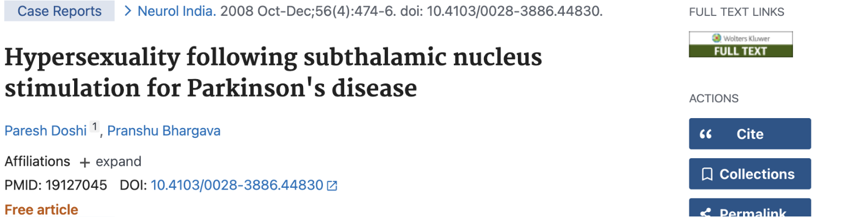
Doshi P, Bhargava P. “Hypersexuality following subthalamic nucleus stimulation for Parkinson’s disease.” Neurol India. 2008;56(4):474–476.
Doshi PK, Chhaya N, Bhatt MH. “Depression leading to attempted suicide after bilateral subthalamic nucleus stimulation for Parkinson’s disease.” Mov Disord. 2002;17(5):1084–1085. Full text: neurologicalsurgery.in/wp-content/uploads/2025/01/Depression-leading-to-suicide-following-STN-DBS.pdf
[Kareena/Ankit: I couldn’t capture a clean title screenshot for this one — Chrome’s PDF viewer blocked it. Please grab a screenshot directly from the PDF at the link above.]
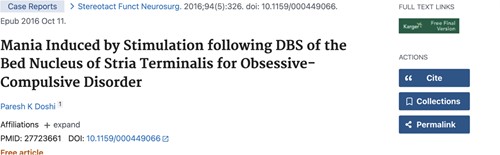
Doshi PK. “Mania Induced by Stimulation following DBS of the Bed Nucleus of Stria Terminalis for Obsessive-Compulsive Disorder.” Stereotact Funct Neurosurg. 2016;94(5):326.
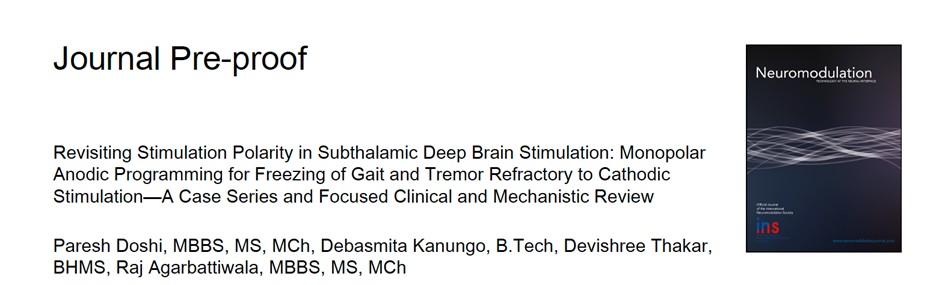
[Note to Paresh: you mentioned a recent paper on anodic stimulation as the latest in this series — I searched but couldn’t confirm the exact citation under your name; please send the title/journal so it can be added correctly rather than guessed at.]
Jaslok’s DBS programming team is recognized as one of a small number of centers of excellence for DBS programming by a leading device manufacturer — worth naming directly once you confirm which manufacturer you’d like credited.
Beyond any one hospital’s numbers, here are three questions worth asking whoever you’re considering:
What are the main risks of DBS surgery?
The main surgical risks are hemorrhage, infection, and inaccurate lead placement. Separately, stimulation/programming can occasionally cause mood or behavioral side effects, which are managed by adjusting the device settings.
How common are complications?
In our own 20-year, 519-case series, the complication rate fell from 23% in the first 100 cases to 7% in the most recent 100 cases, and in the last 300 patients, we virtually had no complications and no mortality in our series, — in line with published international data showing DBS is safe with acceptably low complication rates.
Can side effects from DBS programming be managed?
Yes. Stimulation-related side effects such as mood changes are typically identified during follow-up programming visits and resolved by adjusting stimulation settings.
How do I choose a safe, experienced DBS surgeon?
Ask about their personal DBS case volume (not general neurosurgery volume), whether they’ve operated consistently at one center, and whether they’ve published their own outcomes and complication data.
Drafted from Dr. Doshi’s brief, with all publication details verified against PubMed/Karger before inclusion. Two items above need his confirmation before this goes live: the anodic stimulation citation, and the device manufacturer name for the “center of excellence” line.
WhatsApp us