
India’s Pioneer DBS Programme Since 1998 | 750+ DBS Surgeries Performed by Prof. Dr. Paresh K. Doshi
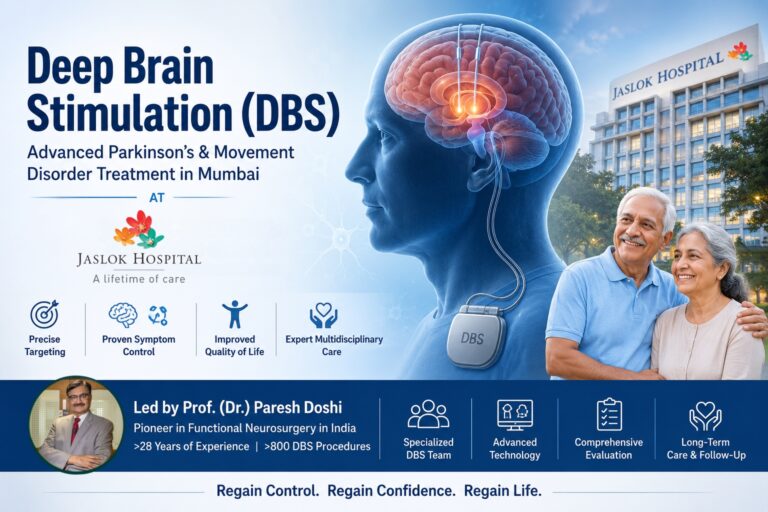
Regain control over movement. Improve quality of life. Receive personalised care from one of India’s most experienced Functional Neurosurgery programmes.
For many people living with Parkinson’s disease, Essential Tremor, Dystonia, and other movement disorders, medications gradually become less effective over time. Tremors become more noticeable, stiffness worsens, involuntary movements develop, and simple daily activities become increasingly difficult.
Deep Brain Stimulation (DBS) is an advanced, evidence-based surgical treatment that can significantly improve movement symptoms in carefully selected patients. At Jaslok Hospital, Mumbai, Prof. Dr. Paresh K. Doshi has been at the forefront of DBS surgery in India since 1998, leading one of the country’s longest-running and most experienced Functional Neurosurgery programmes.
With more than 750 Deep Brain Stimulation procedures personally performed at a single centre, Prof. Dr. Doshi combines decades of surgical expertise with advanced imaging, precision targeting, personalised programming, and multidisciplinary care to help patients achieve the best possible outcomes.
Whether you have recently been advised to consider DBS or are seeking a second opinion, our team is committed to guiding you through every stage of your treatment journey with clarity, compassion, and clinical excellence.
Choosing the right DBS programme is one of the most important decisions a patient with Parkinson’s disease or another movement disorder will make. Successful outcomes depend not only on the surgery itself but also on accurate patient selection, meticulous planning, precise electrode placement, and long-term programming.
Prof. Dr. Paresh K. Doshi has dedicated nearly three decades exclusively to Functional Neurosurgery, making him one of India’s most experienced DBS surgeons.
Every patient receives an individualised treatment plan rather than a standard protocol, ensuring that surgical targets, device selection, and programming strategies are tailored to their unique symptoms and goals.
Deep Brain Stimulation (DBS) is an advanced neurosurgical procedure used to treat movement disorders and selected neurological and psychiatric conditions when medications no longer provide satisfactory symptom control.
Unlike traditional brain surgery, DBS does not destroy brain tissue. Instead, it uses carefully placed electrodes to deliver controlled electrical stimulation to specific areas of the brain that regulate movement and other neurological functions.
These electrical impulses help restore more normal communication within brain circuits, reducing symptoms such as tremors, stiffness, slowness of movement, involuntary movements, and disabling motor fluctuations.
The system consists of three main components:
One of the greatest advantages of DBS is that the stimulation can be adjusted after surgery. Unlike irreversible procedures, DBS is programmable, allowing treatment to be fine-tuned over time as the patient’s condition changes.
Movement disorders such as Parkinson’s disease occur because certain brain circuits no longer communicate effectively.
In Parkinson’s disease, the loss of dopamine-producing nerve cells disrupts the normal functioning of the basal ganglia, a group of deep brain structures responsible for controlling movement.
As a result, patients may experience:
During DBS surgery, electrodes are implanted into carefully selected brain targets such as the Subthalamic Nucleus (STN), Globus Pallidus Internus (GPi), or Ventral Intermediate Nucleus (VIM), depending on the patient’s diagnosis and symptoms.
These electrodes deliver gentle electrical impulses that help regulate abnormal brain activity and improve motor control.
DBS does not cure Parkinson’s disease or stop its progression. However, in appropriately selected patients, it can significantly improve quality of life, reduce disabling symptoms, and decrease dependence on medication.
Deep Brain Stimulation is used to treat a variety of neurological conditions when symptoms become difficult to manage with medication alone.
Parkinson’s Disease
Parkinson’s disease is the most common condition treated with DBS.
Patients experiencing medication fluctuations, wearing-off symptoms, troublesome dyskinesia, or disabling tremors may benefit from surgery.
Many patients experience improvements in:
If you are experiencing severe tremors, stiffness, motor fluctuations, or dyskinesias despite optimal medication, DBS may be the right option.
Essential Tremor
Essential Tremor is one of the most common movement disorders and often affects the hands, making daily activities such as eating, writing, and drinking difficult.
When medications fail to provide adequate control, DBS can significantly reduce tremor severity and restore independence.
Dystonia
Dystonia causes sustained muscle contractions leading to abnormal postures and repetitive movements.
For carefully selected patients with primary dystonia, DBS has been shown to provide substantial long-term improvements in motor function and quality of life.
Obsessive Compulsive Disorder (OCD)
For a small group of patients with severe treatment-resistant OCD, DBS may be considered after extensive evaluation by a multidisciplinary team when conventional therapies have been unsuccessful.
Epilepsy
DBS may also be considered in selected patients with drug-resistant epilepsy who are not suitable candidates for other forms of epilepsy surgery.
Tourette Syndrome
In rare, carefully selected cases, DBS may be offered to patients with severe Tourette Syndrome whose symptoms remain disabling despite comprehensive medical treatment.
One of the most common misconceptions is that DBS should only be considered when Parkinson’s disease reaches its final stages.
In reality, modern research has shown that carefully selected patients often achieve the greatest benefit when surgery is performed before severe disability develops.
You may be a candidate for DBS if you:
A detailed assessment by a multidisciplinary movement disorders team is essential to determine whether DBS is the most appropriate treatment option for you.
Choosing a Deep Brain Stimulation (DBS) programme involves much more than selecting an experienced surgeon. The success of DBS depends on accurate patient selection, meticulous planning, advanced surgical technology, precise electrode placement, and long-term programming after surgery.
At Jaslok Hospital, Mumbai, Prof. Dr. Paresh K. Doshi leads one of India’s longest-running and most comprehensive Functional Neurosurgery programmes. Established in 1998, the programme has evolved continuously by incorporating advanced imaging, precision stereotactic technology, multidisciplinary care, and personalised treatment planning.
Unlike conventional treatment pathways that focus only on surgery, every patient entering our DBS programme undergoes an extensive evaluation to ensure that surgery is the right option and that every aspect of treatment is tailored to their individual needs.
Deep Brain Stimulation is not a single operation. It is a long-term partnership between the patient and a multidisciplinary team.
What truly differentiates our programme is not only surgical expertise but also the systems, technology, planning, and follow-up that support better outcomes.
Since introducing Deep Brain Stimulation in India in 1998, Prof. Dr. Paresh K. Doshi has personally performed more than 750 DBS procedures at Jaslok Hospital.
This represents one of India’s largest single-surgeon DBS experiences accumulated continuously over nearly three decades at one institution.
This experience enables the team to manage not only routine DBS procedures but also complex and challenging cases requiring advanced planning or revision surgery.
Functional Neurosurgery is a highly specialised field requiring years of focused experience.
For over 28 years, Prof. Dr. Doshi has devoted his practice to treating movement disorders, epilepsy, pain disorders, and psychiatric conditions using stereotactic and functional neurosurgical techniques.
This focused expertise allows patients to benefit from decades of accumulated clinical experience rather than a general neurosurgical practice.
No two patients experience Parkinson’s disease in exactly the same way.
Some patients are troubled primarily by tremor, while others struggle with stiffness, slowness, balance difficulties, dyskinesia, or freezing of gait.
For this reason, our programme follows a personalised approach to DBS rather than applying a standard treatment protocol.
Treatment planning is individualised based on:
This personalised strategy helps optimise outcomes while preserving future treatment options.
One of the reasons our programme has consistently achieved favourable outcomes is the emphasis placed on patient selection.
Not every patient with Parkinson’s disease requires DBS surgery.
Before surgery is recommended, patients undergo an extensive multidisciplinary assessment designed to answer one critical question:
Will this patient genuinely benefit from DBS?
Our evaluation process includes:
Neurological Assessment
A Movement Disorder Neurologist performs a comprehensive evaluation to assess:
When performed by an experienced functional neurosurgeon in a reputed center like Jaslok Hospital, DBS is considered safe and effective. As with any brain surgery, risks exist, but careful patient selection and surgical precision significantly reduce complications.
Neuropsychological Assessment
Cognitive function plays an important role in determining surgical suitability.
Detailed neuropsychological testing helps identify:
This assessment ensures that DBS is offered to patients who are most likely to benefit safely.
Advanced Neuroimaging
Every patient’s brain anatomy is unique.
High-resolution imaging allows surgeons to identify the optimal surgical targets with greater precision.
Advanced imaging also assists in surgical planning while minimising potential risks.
Multidisciplinary Review
Each patient’s case is discussed collaboratively by specialists from multiple disciplines before surgery is recommended.
This ensures that every treatment decision is based on collective expertise rather than a single opinion.
Successful DBS extends far beyond the operating room.
Patients benefit from coordinated care provided by specialists working together throughout diagnosis, surgery, programming, and long-term follow-up.
Our multidisciplinary team includes:
Functional Neurosurgeon
Prof. Dr. Paresh K. Doshi leads the surgical programme and performs Deep Brain Stimulation procedures using advanced stereotactic techniques.
Movement Disorder Neurologist
Responsible for:
Neuropsychologist
Performs detailed cognitive evaluation before surgery and monitors neuropsychological outcomes following DBS.
Psychiatrist
Supports patients with:
Gastroenterologist
Assesses non-motor symptoms including:
Urologist
Evaluates bladder dysfunction commonly associated with Parkinson’s disease.
Pain Physician
Helps manage chronic pain conditions that frequently accompany advanced neurological disorders.
Deep Brain Stimulation requires extraordinary precision.
A deviation of even a few millimetres may affect symptom control.
For this reason, surgical expertise must be complemented by advanced technology that enables accurate planning and precise electrode placement.
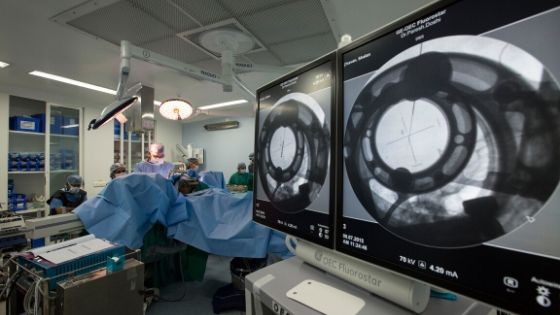
Prof. Dr. Doshi’s programme utilises the SUSY (Surgical Utility System), an advanced stereotactic platform designed to support highly accurate brain targeting during Functional Neurosurgery.
The system allows surgeons to plan complex trajectories with exceptional precision while minimising disruption to surrounding brain tissue.
Accurate targeting contributes to improved symptom control and supports safer, more reproducible surgical outcomes.
Conventional MRI does not always clearly visualise the deep brain structures involved in DBS surgery.
Our programme incorporates Quantitative Susceptibility Mapping (QSM), an advanced MRI technique that enhances visualisation of critical targets such as:
Improved visualisation assists surgeons in planning more precise electrode placement based on each patient’s individual anatomy.
Brain anatomy varies slightly from one patient to another.
To further improve surgical accuracy, Microelectrode Recording (MER) may be used during surgery.
MER records the electrical activity of individual neurons within specific brain structures.
By analysing these characteristic signals, surgeons can confirm that the electrode is positioned within the intended target before permanent implantation.
This additional layer of physiological confirmation supports highly accurate targeting.
Depending on the patient’s condition and clinical requirements, DBS surgery may be performed using either an awake or asleep approach.
Awake DBS
During awake surgery:
Asleep DBS
Selected patients may undergo DBS under general anaesthesia.
Advanced imaging techniques enable accurate electrode placement while the patient remains asleep throughout the procedure.
The choice between awake and asleep DBS is made after careful evaluation and discussion with the patient.
Our team follows a structured pathway designed to ensure safety, precision, and optimal outcomes.
Step 1 – Initial Consultation
A comprehensive assessment of symptoms, medical history, previous treatments, and treatment goals.
Step 2 – Multidisciplinary Evaluation
Patients undergo neurological, neuropsychological, imaging, and medical assessments to determine suitability.
Step 3 – Personalised Surgical Planning
Brain imaging is analysed to identify the most appropriate target for each patient.
Target selection depends on:
Step 4 – DBS Surgery
Electrodes are implanted into carefully selected brain targets using advanced stereotactic techniques.
These electrodes are connected to a neurostimulator implanted beneath the skin of the chest.
Step 5 – Initial Programming
Several weeks after surgery, the DBS system is activated and programmed.
Programming is individualised to maximise symptom improvement while minimising side effects.
Step 6 – Long-Term Follow-Up
DBS is not a one-time treatment.
Patients continue regular follow-up visits for:
This ongoing partnership allows treatment to evolve alongside the patient’s condition.
Not every patient referred to our programme is seeking their first DBS procedure.
Some patients have previously undergone DBS elsewhere but continue to experience unsatisfactory symptom control.
Our programme has extensive experience in evaluating such cases to determine whether improvements can be achieved through advanced programming, optimisation, or revision surgery when appropriate.
Careful assessment helps identify the underlying cause of persistent symptoms and guides the most appropriate treatment strategy.
Why This Matters
Deep Brain Stimulation is one of the most sophisticated procedures in modern neurosurgery. While the operation itself is important, long-term outcomes are shaped by the quality of evaluation, precision of planning, advanced technology, and ongoing multidisciplinary care.
At Jaslok Hospital, Prof. Dr. Paresh K. Doshi’s programme combines nearly three decades of experience with a personalised, evidence-based approach, giving patients access to comprehensive care from initial assessment through lifelong follow-up.
One of the most common concerns patients have is, “How long will it take to recover after DBS surgery?“
Recovery is a gradual process. While the surgery itself is completed over one or two stages depending on the treatment plan, the full benefits of Deep Brain Stimulation develop over the following weeks and months as stimulation settings are adjusted and medications are optimized.
Every patient’s recovery journey is unique, and our multidisciplinary team provides continuous support throughout this period.
During Your Hospital Stay
Immediately after surgery, patients are monitored closely to ensure a smooth recovery.
The medical team evaluates:
Most patients are encouraged to begin walking within a day after surgery, depending on their condition.
First Few Weeks
During the first few weeks:
This healing period allows swelling around the electrodes to subside before programming begins.
Initial DBS Programming
The first programming session generally takes place a few weeks after surgery.
This is one of the most important stages of treatment.
Using a specialised programming device, the stimulation settings are adjusted according to each patient’s symptoms.
Parameters including:
are carefully modified to maximise symptom control while minimising side effects.
Programming is an ongoing process rather than a one-time adjustment.
One of the greatest advantages of DBS is that treatment continues to evolve with the patient.
Unlike medications that may gradually lose effectiveness, DBS settings can be modified whenever symptoms change.
Many patients experience improvements in:
Some patients are also able to reduce certain Parkinson’s medications under the supervision of their neurologist.
Although DBS does not cure Parkinson’s disease or stop disease progression, it can provide meaningful long-term symptom control in appropriately selected patients.
Our relationship with patients continues long after surgery.
Regular follow-up appointments allow the team to:
Because Parkinson’s disease changes over time, DBS therapy is continuously personalised throughout the patient’s journey.
Not every patient referred to our programme is undergoing their first DBS surgery.
Some patients come to us after having DBS performed elsewhere.
Persistent symptoms do not always indicate that surgery has failed.
In many cases, significant improvements can be achieved through:
Only a small proportion of patients require revision surgery after careful evaluation.
Our experience with complex DBS cases enables us to identify the most appropriate strategy for each patient.
Clinical excellence is strengthened by continuous research.
Alongside patient care, Prof. Dr. Paresh K. Doshi has contributed extensively to advancing Functional Neurosurgery through research, education, and innovation.
His work focuses on improving the accuracy, safety, and long-term outcomes of Deep Brain Stimulation.
One of the most exciting areas of ongoing research within our programme is the development of Artificial Intelligence tools to predict Freezing of Gait (FOG) in patients with Parkinson’s disease.
Freezing of Gait is one of the most disabling motor symptoms of Parkinson’s disease.
Patients suddenly feel as though their feet are “stuck” to the ground, increasing the risk of falls and reducing independence.
Prof. Dr. Paresh K. Doshi is leading research in collaboration with international experts to develop AI-based predictive models that may help identify patients at risk before severe symptoms develop.
This research has received national media attention and reflects our commitment to bringing innovation from research into clinical practice.
Innovation is driven by collaboration.
Our programme actively collaborates with leading international researchers and institutions working in Functional Neurosurgery, neuroimaging, and Parkinson’s disease.
These collaborations help translate the latest scientific developments into patient care while ensuring that treatment strategies remain aligned with evolving international standards.
Prof. Dr. Paresh K. Doshi continues to contribute to the global Functional Neurosurgery community through:
He has also been appointed Organising Chairman of the 15th Asian-Australasian Society for Stereotactic and Functional Neurosurgery (AASSFN) World Congress, reflecting his continued contribution to the field.
Mr. Suresh Menon, a 59-year-old IT professional, was diagnosed with Parkinson’s Disease in 2015. Over the years, he developed severe tremors, rigidity, slowness of movements, and disabling motor fluctuations that progressively affected both his personal and professional life.
Despite increasing medications, his symptoms continued to worsen, eventually forcing him to voluntarily resign from his job due to declining functional abilities and reduced quality of life.
After comprehensive evaluation, he was found suitable for Deep Brain Stimulation surgery and underwent the procedure in January 2025 under the care of Dr. Paresh Doshi.
Following surgery and personalized DBS programming, Mr. Menon experienced remarkable improvement in tremors, mobility, rigidity, and motor fluctuations.
Today, one year after DBS surgery, he has regained independence in daily activities, enjoys an active social life, and has rediscovered his passion for hobbies and writing.
His journey reflects the life-changing impact DBS can have when performed with the right diagnosis, expertise, and long-term follow-up care. Click to Read full story
Mr. Mahindra Pawar, a 54-year-old event organizer working at the Mantralaya, spent most of his professional life managing large-scale events that demanded coordination, leadership, communication, and constant activity. Known for his disciplined work ethic and energetic personality, he took great pride in handling responsibilities with confidence and precision.
Around 2011, he gradually began noticing subtle changes in his movements. Over time, slowness, stiffness, and increasing difficulty performing routine activities started affecting both his personal and professional life. Despite these challenges, he continued fulfilling his responsibilities with determination, refusing to let his condition interfere with his commitment to work.
As the years progressed, the symptoms became more disabling and emotionally exhausting. Activities that once felt effortless started requiring significant effort, and the growing physical limitations slowly affected his confidence and overall quality of life.
After comprehensive medical evaluation, Mr. Pawar was diagnosed with Parkinson’s Disease. Initially, medications provided partial relief, but over time, fluctuations in symptom control and worsening physical limitations continued to impact his daily functioning.
Considering the progression of symptoms and their effect on his independence and career, he was evaluated for Deep Brain Stimulation surgery and successfully underwent the procedure on 16/02/2022 under the care of Dr. Paresh Doshi.
Following DBS surgery and long-term follow-up care, Mr. Pawar experienced significant improvement in mobility, stiffness, and overall functional capacity. Most importantly, he gradually regained the confidence and independence that Parkinson’s Disease had slowly taken away over the years.
Over the past four years, he has steadily returned to his normal routine and resumed his professional responsibilities with renewed confidence and energy. One of the most meaningful milestones in his recovery journey was successfully organizing a major office event once again — an achievement that symbolized not just professional success, but also his return to the life and identity he once feared losing.
Even four years after DBS surgery, his symptoms remain under very good control, allowing him to continue working actively, independently, and confidently.
His journey is a powerful example of the long-term benefits of DBS when combined with the right diagnosis, expert surgical care, continuous follow-up, and personal determination. Click to Read full story
Deep Brain Stimulation (DBS) is an advanced surgical treatment used to manage movement disorders such as Parkinson’s disease, tremors, and dystonia. It involves placing electrodes in specific areas of the brain that deliver controlled electrical impulses to regulate abnormal brain activity.
Patients with Parkinson’s disease or movement disorders who continue to experience tremors, stiffness, slowness, or medication-related complications despite optimal medicines may be suitable candidates for DBS surgery.
No, DBS is not a cure for Parkinson’s disease. However, it can significantly improve symptom control, reduce tremors and stiffness, and improve quality of life in properly selected patients.
DBS is commonly used to treat:
When performed by an experienced functional neurosurgeon and specialized DBS team, DBS surgery is considered safe and effective. Careful planning and advanced technology help minimize risks and complications.
The complete duration of Deep Brain Stimulation (DBS) surgery, including pre and post hospitalization, is usually around 12 days. However, the actual surgical procedure is generally completed in two stages over 2 days.
On the first day, the brain surgery is performed, during which the electrodes are carefully placed in the targeted areas of the brain. On the second day, the IPG (Implantable Pulse Generator), also known as the battery device, is implanted and connected to the electrodes.
Many patients experience a significant reduction in medication requirements after DBS surgery. However, some medications may still be needed depending on the condition and response to treatment.
Benefits of DBS may include:
The lifespan of the DBS battery depends on the type of device used. Non-rechargeable batteries may last several years, while rechargeable systems can last longer with regular charging.
Prof. (Dr.) Paresh Doshi is one of India’s leading functional neurosurgeons with over 28 years of experience and more than 800 DBS procedures. He is recognized internationally for his expertise in advanced DBS surgery and long-term patient care.
After surgery, the device is activated and programmed after the healing period. Multiple follow-up sessions may be needed to optimize stimulation settings and improve symptom control.
The cost of Deep Brain Stimulation (DBS) surgery in Mumbai generally ranges between ₹13.5 lakhs to ₹30 lakhs, depending on several factors such as the type of DBS device used, whether the system is rechargeable or non-rechargeable, the patient’s medical condition, hospital infrastructure, and post-surgery programming requirements.
Yes, DBS surgery is a completely reversible procedure. The implanted system can be adjusted, turned off, or removed if required.
Deep Brain Stimulation (DBS) is used to treat several neurological conditions, including Parkinson’s Disease, Dystonia, Essential Tremor, Epilepsy, and certain cases of Obsessive-Compulsive Disorder (OCD). It is primarily recommended for patients whose symptoms are not adequately controlled with medications.
Many patients start noticing improvement within a few days to a few weeks after the DBS device is activated and programmed. However, the full benefits of DBS are usually seen in 3 months after DBS Surgery as the stimulation settings are adjusted according to the patient’s symptoms and response.
The top-rated hospitals for Deep Brain Stimulation (DBS) surgery in Mumbai are known for their advanced neurosurgery departments, experienced functional neurosurgeons, and multidisciplinary Parkinson’s care teams. Hospitals like Jaslok Hospital & Research Centre are one of India’s most experienced centers for DBS surgery and functional neurosurgery. The hospital is widely recognized for Parkinson’s Disease treatment and advanced DBS programs led by Dr. Paresh Doshi, a pioneer of DBS surgery in India.
Total 10 – 12 days of Hospitalisation is required which includes pre surgery assessments, DBS Surgery, and post surgery programming
WhatsApp us