
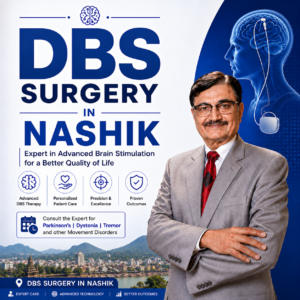
For a person living with Parkinson’s disease, there can come a point when medicines that once provided good control no longer offer the same relief. Tremors may become more persistent, movements may become slower, stiffness may interfere with everyday activities, and medication-related fluctuations or dyskinesias may begin affecting quality of life.
For appropriately selected patients, Deep Brain Stimulation (DBS) can be an important treatment option.
Patients from Nashik and surrounding areas can consult Dr. Paresh Doshi, Senior Neurosurgeon at Jaslok Hospital, Mumbai, for evaluation and DBS treatment.
The decision to undergo DBS should always be based on a detailed individual assessment. DBS is not a cure for Parkinson’s disease, and not every patient is a candidate. However, when appropriately selected, DBS can provide meaningful improvement in certain motor symptoms and may help patients regain greater control over their daily routines.
When Parkinson’s disease began significantly affecting his wife’s quality of life, Pravin Kulkarni and his family from Nashik were faced with an important decision: whether to consider brain surgery and, if so, whom they could trust with it.
After researching DBS and consulting their neurologist, the family travelled to Mumbai to meet Dr. Paresh Doshi.
His wife’s experience ultimately led them to choose DBS surgery at Jaslok Hospital.
“My wife has been suffering from Parkinson’s disease since June 2019. Until 2024, her condition was reasonably well controlled with medications prescribed by her neurologist. However, thereafter her symptoms worsened significantly despite increasing doses of medicines. She suffered from severe tremors, dyskinesia, rigidity, and other debilitating symptoms that affected her quality of life.”
“Our neurologist recommended Deep Brain Stimulation (DBS) surgery. Initially, my wife was reluctant to undergo brain surgery after reading information available online. As a family, we decided to gather more information and search for the most experienced DBS neurosurgeon in Mumbai.”
“During our search, we came across Dr. Paresh Doshi, Senior Neurosurgeon at Jaslok Hospital. After learning about his expertise and extensive experience with DBS surgery, we decided to consult him. Our very first meeting with Dr. Doshi gave us complete confidence. His calm approach, clear explanations, and compassionate guidance helped us overcome our fears and make an informed decision.”
“My wife underwent DBS surgery on 7th August 2026 at Jaslok Hospital. By the grace of God and due to the exceptional skill of Dr. Paresh Doshi and his dedicated team, the surgery was a great success. After the surgery, her tremors, dyskinesia, rigidity, and several other Parkinson’s symptoms reduced dramatically. Most remarkably, the dosage of her Parkinson’s medications has been reduced to an extent that we had never imagined possible.”
“Dr. Paresh Doshi is not only an outstanding neurosurgeon but also a truly compassionate and humble human being. His vast knowledge, surgical excellence, and reassuring nature gave us confidence throughout this challenging journey.”
“I would also like to express my sincere gratitude to the entire DBS team, doctors, nurses, technicians, and all the staff of Jaslok Hospital for their professionalism, care, hospitality, and unwavering support during our stay.”
“Our family will always remain thankful to Dr. Paresh Doshi and the entire Jaslok Hospital team for giving my wife a new lease on life and restoring hope and happiness to our family.”
Pravin Kulkarni
Nashik, Maharashtra
Deep Brain Stimulation, commonly called DBS, is a surgical treatment in which thin electrodes are placed in specific areas of the brain involved in controlling movement.
These electrodes are connected to a neurostimulator, which delivers controlled electrical stimulation to the targeted brain region.
DBS may be considered for appropriately selected patients with conditions such as:
DBS does not remove Parkinson’s disease from the body and does not stop the underlying disease from progressing. Its purpose is to help control symptoms that are responsive to stimulation.
DBS is not necessarily the first treatment used for Parkinson’s disease. Many patients initially achieve good symptom control with medication.
Over time, however, some patients may experience increasing difficulty controlling their symptoms.
A DBS evaluation may be considered when a patient experiences problems such as:
Medication Wearing Off
The benefit of Parkinson’s medication may not last as long as it previously did, resulting in periods when symptoms return before the next dose.
Motor Fluctuations
A patient may move relatively well at some times and experience significant slowness or stiffness at others.
Dyskinesia
Involuntary movements associated with Parkinson’s medication can become troublesome in some patients.
Tremor
Some patients continue to experience disabling tremor despite medication.
Difficulty With Daily Activities
Symptoms may increasingly interfere with walking, dressing, eating, writing, working or other everyday activities.
The important question is not simply whether a person has Parkinson’s disease.
The important question is:
“Could DBS provide meaningful benefit for this particular patient?”
That requires a detailed evaluation by an experienced DBS team.
Patients between 45 and 75 years of age can have very different lifestyles and responsibilities.
A person with Parkinson’s disease may be:
The impact of Parkinson’s disease is therefore not measured only by tremor or rigidity.
It can also be measured by the things a person gradually finds difficult to do.
For one person, it may be continuing to work.
For another, it may be walking around the farm.
For someone else, it may be writing, eating independently, travelling, managing a business or spending active time with family.
DBS should be considered in the context of the person’s overall health, symptoms, medication response, expectations and individual circumstances.
For appropriately selected patients, DBS can help improve certain motor symptoms.
Depending on the individual patient and the brain target selected, potential benefits may include improvement in:
DBS may also allow medication adjustments in some patients.
However, the outcome varies from person to person.
Some Parkinson’s symptoms may respond better than others, and symptoms such as speech, balance, cognition or other non-motor problems may not improve with DBS and can sometimes continue to progress.
This is why careful patient selection is one of the most important parts of DBS treatment.
Nashik patients may naturally ask:
“Why should I travel to Mumbai when I can look for treatment closer to home?”
This is a reasonable question.
When considering DBS, however, the decision should not be based only on the distance between two cities.
DBS is a treatment journey that involves much more than the operation itself.
Evaluation
Determining whether DBS is appropriate for the patient.
↓
Treatment Planning
Selecting the appropriate surgical approach and brain target based on the patient’s condition.
↓
DBS Surgery
Implantation of the stimulation system.
↓
Programming
Adjusting stimulation settings after surgery.
↓
Medication Optimisation
Adjusting Parkinson’s medication as clinically appropriate.
↓
Long-Term Follow-Up
Monitoring the patient’s symptoms and making further adjustments when required.
For this reason, patients and families often consider the experience of the DBS team, surgical expertise, patient selection and long-term programming support alongside geographical convenience.
For a patient from Nashik, travelling to Mumbai may initially feel like an additional burden.
But DBS is not a treatment where the decision should be made solely on the basis of the number of kilometres between home and hospital.
A more important question is:
“Where can I receive the appropriate evaluation, surgical care and DBS management for my condition?”
Nashik is also relatively close to Mumbai compared with many other cities from which patients travel for DBS treatment.
With appropriate planning, the patient’s consultation, investigations, surgery, hospital stay and follow-up can be coordinated to minimise unnecessary travel.
Before travelling, patients can discuss their medical history and previous reports with the treating team so that the visit can be planned appropriately.
Understanding the Difference Between Treatment Cost and Travel Expenses
Cost is one of the most common concerns for families considering DBS.
Some patients assume that travelling to Mumbai automatically means that the DBS treatment itself will cost substantially more.
This is not necessarily the case.
The DBS treatment cost is determined by the medical treatment, procedure, device and hospital-related components involved in the patient’s care.
Travelling from Nashik may add expenses such as:
However, the DBS treatment cost itself is not increased simply because a patient comes from Nashik rather than living in Mumbai.
Patients should always ask for a clear, current estimate of the treatment package and what it includes before making financial decisions.
DBS Does Not End With the Operation
One of the most important things for a patient to understand is that DBS surgery is only one part of the treatment.
After implantation, the DBS system needs to be programmed and adjusted according to the patient’s symptoms and response.
The process may involve:
Surgery → Initial programming → Observation → Adjustment → Medication optimisation → Follow-up
The settings may need to be adjusted over time.
This is why access to an experienced DBS team for programming and follow-up is an important consideration when choosing where to undergo treatment.
After DBS surgery, the implanted neurostimulator is programmed to deliver stimulation according to the patient’s individual requirements.
The doctor may adjust parameters such as stimulation settings while observing the patient’s symptoms and response.
The goal is to find an appropriate balance between symptom control and side effects.
Programming is therefore an important part of the DBS journey.
The video can help patients and families understand what DBS follow-up actually looks like after surgery.
Before Your First Visit
Patients can keep their previous medical records ready, including:
The DBS team can then advise what further evaluation may be required.
During the Evaluation
The patient may undergo a detailed assessment to determine:
DBS should only be recommended when the potential benefits and risks are appropriate for the individual patient.
If DBS Surgery Is Recommended
The medical team will explain the procedure, expected hospital stay, recovery process, programming and follow-up requirements.
The patient’s family can then make an informed decision about proceeding with surgery.
After Returning to Nashik
Once the patient returns home, follow-up continues according to the treating team’s recommendations.
Patients should understand that DBS settings and medications may need adjustment over time.
The exact follow-up schedule is individualised and should be discussed with the treating team before travelling home.
Dr. Paresh Doshi is a Senior Neurosurgeon at Jaslok Hospital, Mumbai, with a focus on functional neurosurgery and movement disorders, including Deep Brain Stimulation.
For patients travelling from Nashik, the decision to choose a DBS surgeon is about more than the operation itself.
It is about finding a team that can guide the patient through:
Dr. Doshi’s approach focuses on careful assessment and individualised treatment planning rather than treating every DBS patient in exactly the same way.
DBS requires more than placing electrodes in the brain.
The treatment involves decisions at multiple stages:
Who should undergo DBS?
Which symptoms are likely to respond?
Which target should be selected?
How should surgery be planned?
How should stimulation be programmed?
How should medication be adjusted?
The quality of these decisions can influence the patient’s overall treatment journey.
For this reason, patients should consider the experience of the entire DBS team and not simply compare hospitals based on distance or advertised procedure costs.
No. DBS is not a cure for Parkinson’s disease. It is a treatment that can help control certain symptoms in appropriately selected patients.
There is no single age that automatically makes someone suitable or unsuitable for DBS. A patient’s overall health, symptoms, disease characteristics, cognitive status, medication response and other factors are considered.
Age alone does not determine suitability. A 70-year-old may be considered for DBS if the overall medical and neurological assessment suggests that the potential benefits outweigh the risks.
DBS can provide significant improvement in tremor for appropriately selected patients. The expected benefit depends on the patient’s diagnosis, symptoms and other clinical factors.
Medication requirements may be reduced in some patients following DBS, depending on their symptoms and clinical response. Medication should only be changed under the guidance of the treating doctor.
No. DBS does not stop the underlying progression of Parkinson’s disease.
The duration can vary depending on the surgical approach, patient and treatment plan. The treating team can provide the patient with a more specific estimate after evaluation.
The required stay depends on the patient’s evaluation, procedure, recovery and programming requirements. Patients travelling from Nashik should discuss the expected timeline with the hospital team before making travel arrangements.
Follow-up requirements vary between patients. Programming and medication adjustments are an important part of DBS care, and the treating team will advise the patient about the appropriate follow-up schedule.
DBS programming involves adjusting the settings of the implanted stimulation system to achieve an appropriate balance between symptom control and side effects.
Yes. Programming is an important component of DBS treatment and may require adjustments over time.
The fact that a patient lives in Nashik does not itself increase the DBS treatment cost. However, patients should separately consider travel, accommodation and other personal expenses.
Patients may consider travelling to Mumbai based on the experience of the treating team, DBS expertise, surgical planning, programming and long-term management, rather than choosing a centre solely because it is geographically closer.
A detailed evaluation is required. Your neurologist or DBS team will consider your diagnosis, symptoms, medication response, medical history, cognitive status and other factors before recommending DBS.
Patients should contact the hospital/team to understand the available consultation process and whether their initial assessment can be coordinated before travelling.
If Parkinson’s disease is increasingly affecting your movement, independence, work, family life or everyday activities despite medication, it may be appropriate to discuss whether DBS could be an option.
The first step is not deciding to undergo surgery.
The first step is understanding whether DBS is right for you.
call DBS team – 91 9930990777
WhatsApp the DBS Team – 91 9930990777
Every DBS patient is different. The potential benefits, risks, suitability for surgery and expected outcomes vary depending on individual medical and neurological factors.
The information on this page is intended for general education and should not replace an individual medical consultation.
DBS should only be considered after a comprehensive assessment by an appropriately qualified medical team.
Patient outcomes vary and no specific result can be guaranteed.
WhatsApp us