
last updated on 6 August 2026
Deep Brain Stimulation surgery in Mumbai is one of the most effective and advanced treatments for patients suffering from Parkinson’s Disease, tremors, and movement disorders—especially when medications stop working effectively.
If you or your loved one is experiencing worsening symptoms despite treatment, DBS surgery offers a scientifically proven way to regain control over movement, reduce symptoms, and improve quality of life.
With decades of experience in functional neurosurgery, Dr. Paresh Doshi is among India’s most trusted experts in Deep Brain Stimulation, known for precision, outcomes, and patient-focused care.
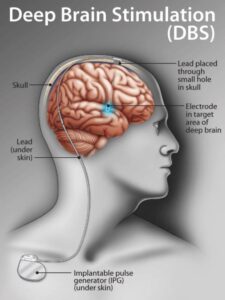
Deep Brain Stimulation (DBS) is a minimally invasive brain surgery that helps regulate abnormal brain activity responsible for movement disorders.
How it works:
Unlike traditional brain surgeries, DBS:
👉 This makes DBS one of the safest and most effective surgical treatments for advanced neurological conditions.
DBS is typically recommended when medications no longer provide consistent relief.
👉 Proper evaluation by an expert like Dr. Paresh Doshi is essential before deciding.
Deep Brain Stimulation is widely used for:
Among these, DBS has shown exceptional success in Parkinson’s patients, especially in reducing tremors and improving mobility.
Deep Brain Stimulation is not suitable for every patient, and deciding the right time for surgery is an important step in treatment.
DBS surgery may be a good option if:
However, DBS may not be recommended if:
A detailed evaluation by an experienced neurosurgeon is essential to determine whether DBS is the right choice based on your individual condition and treatment goals. To know more, read our blog – Who is the right candidate for DBS Surgery
Not every patient with Parkinson’s disease or movement disorders is immediately suitable for Deep Brain Stimulation. A detailed evaluation is essential to ensure the best outcomes.
The evaluation process typically includes:
This careful selection process plays a crucial role in the success of DBS surgery and helps minimize risks while maximizing benefits.
Understanding the full journey of Deep Brain Stimulation can help patients and families feel more confident and prepared for treatment.
The process begins with a detailed consultation where symptoms, medical history, and current treatment response are reviewed.
Patients undergo neurological assessments, imaging (MRI/CT), and cognitive evaluations to determine suitability for DBS surgery.
Advanced imaging and brain mapping techniques are used to precisely identify the target areas in the brain for electrode placement.
The procedure involves implanting electrodes in specific brain regions and placing a pulse generator (battery) under the skin, usually near the chest.
After surgery, the DBS device is carefully programmed and adjusted over multiple sessions to achieve optimal symptom control.
Regular follow-ups ensure that stimulation settings are fine-tuned as the condition evolves, helping maintain long-term benefits.
This structured and carefully monitored approach plays a key role in achieving successful outcomes with DBS surgery.
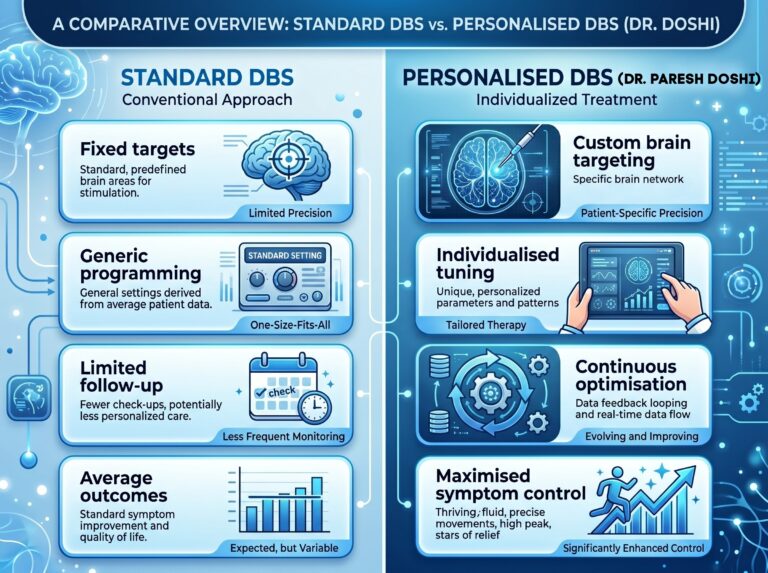
Deep Brain Stimulation is not a one-size-fits-all procedure. One of the key strengths of treatment under Dr. Paresh Doshi is a personalised DBS approach, where every aspect of the surgery and post-operative care is tailored to the individual patient.
Instead of relying on standard protocols, the treatment is customised based on the patient’s specific symptoms, brain structure, disease progression, and treatment goals. This includes precise patient-specific targeting during surgery, real-time intraoperative adjustments, and detailed post-surgery programming to optimise outcomes.
This personalised approach helps maximise symptom control, reduce side effects, and achieve better long-term results compared to a standardised DBS procedure.
Patients undergoing DBS often experience dramatic improvements:
👉 Many patients return to normal daily activities that were previously impossible.
One of India’s most experienced functional neurosurgeons with a strong track record in complex DBS cases.
Advanced targeting and surgical planning ensure accurate electrode placement.
A structured, end-to-end treatment journey for every patient:
👉 Ensuring consistent results and long-term success
The cost of DBS surgery in Mumbai typically ranges between:
👉 ₹14 lakhs to ₹30 lakhs
Factors affecting cost:
👉 Compared to international treatment costs, Mumbai offers world-class care at significantly lower cost.
Deep Brain Stimulation has shown consistently strong results in treating movement disorders, especially Parkinson’s disease.
In addition to symptom control, DBS often helps:
It is important to note that DBS does not cure Parkinson’s disease, but it significantly improves symptom management for many years.
Deep Brain Stimulation (DBS) has been extensively studied worldwide and is widely recognized as an effective treatment for movement disorders such as Parkinson’s disease, dystonia, and essential tremor.
In appropriately selected patients, DBS has been shown to deliver significant and measurable improvements in motor function and quality of life.
Patients undergoing DBS commonly experience:
These improvements directly translate into better day-to-day functioning and greater independence.
Beyond clinical measurements, DBS helps patients regain control over essential daily activities such as:
Long-term follow-up studies show that many patients continue to experience sustained benefits for several years after DBS surgery, particularly when combined with proper device programming and regular medical follow-up.
It is important to understand that while DBS does not cure Parkinson’s disease or other neurological conditions, it significantly improves symptom control, reduces treatment-related complications, and enhances overall quality of life.
The success of DBS depends on several key factors:
When these factors are optimized, DBS can provide consistent and long-lasting improvement in symptoms and functional ability.
✅ Before Surgery:
✅ During Surgery:
✅ After Surgery:
👉 Results improve over time as settings are optimized.
These videos will help you understand the real outcomes of DBS surgery. Symptoms vary from patient to patient and may include tremors, gait difficulties (stiffness while walking), and dyskinesia (uncontrolled involuntary movements).
You can see how these symptoms are managed and improved in the videos below.
Control your tremors
No more hesitancy while walking
Get control of your uncontrollable movements (dyskinesia)
Before DBS:
After DBS:
👉 While DBS does not cure Parkinson’s, it significantly controls symptoms.
Yes, DBS is a globally accepted and well-established procedure.
Possible risks (rare):
With expert surgeons like Dr. Paresh Doshi, risks are minimized and outcomes are highly favorable.
While Deep Brain Stimulation can be highly effective, it is not suitable for every patient.
DBS surgery may not provide optimal results in the following situations:
Proper patient selection is one of the most important factors in achieving successful outcomes. This is why a comprehensive evaluation is always performed before recommending DBS surgery.
Understanding both the benefits and limitations of DBS surgery helps patients make informed and realistic decisions about their treatment.
Deep Brain Stimulation is considered a safe and well-established procedure when performed by experienced neurosurgeons. However, like all surgeries, it carries some risks.
Possible risks include:
Studies show that serious complications are uncommon, and DBS has a strong safety record when patients are properly selected.
The overall risk of major complications remains low, and advances in surgical techniques continue to improve safety and outcomes.
Mumbai is a leading medical hub offering:
Easy access for international patients
If medications are no longer giving the relief they once did, it may be time to explore a more advanced solution.
Deep Brain Stimulation surgery in Mumbai can help you regain control, independence, and confidence.
Consult Dr. Paresh Doshi, one of the Best DBS surgeon in Mumbai today to find out if DBS is the right treatment for you.
Jaslok Hospital & Research Centre is considered one of the top-rated hospitals for Deep Brain Stimulation (DBS) surgery in Mumbai, known for its advanced neurosurgery department, modern infrastructure, and extensive experience in movement disorder surgeries under the leadership of Dr. Paresh Doshi.
Dr. Paresh Doshi is widely regarded as one of the leading neurosurgeons for Deep Brain Stimulation (DBS) surgery in Mumbai and India, with 30+ years of experience in treating Parkinson’s Disease, Dystonia, Essential Tremor, and other neurological disorders.
Patients looking for experienced DBS surgeons in Mumbai often consult Dr. Paresh Doshi at Jaslok Hospital & Research Centre, known for advanced functional neurosurgery and comprehensive Parkinson’s care.
Jaslok Hospital & Research Centre offers advanced DBS surgery with Advance technology, expert neurophysiology support, and one of India’s most experienced DBS teams led by Dr. Paresh Doshi for the last 30 years.
Patients from India and abroad highly appreciate the expertise, surgical outcomes, and patient care provided by Dr. Paresh Doshi for DBS surgery at Jaslok Hospital. To see the real Google review, click here.
Many patients undergoing DBS surgery at Jaslok Hospital & Research Centre have reported significant improvement in tremors, stiffness, and quality of life after treatment under Dr. Paresh Doshi.
Appointments with Dr. Paresh Doshi can be booked through 9930990777 or through Jaslok Hospital & Research Centre’s official consultation channels for DBS evaluation and treatment.
The overall cost of Deep Brain Stimulation (DBS) surgery in Mumbai depends on multiple factors including the DBS device selected, surgical complexity, hospital infrastructure, and long-term programming support. On average, the cost ranges from ₹13.5 lakhs to ₹30 lakhs.
The cost of Deep Brain Stimulation (DBS) surgery at leading Mumbai hospitals, such as Jaslok Hospital, typically ranges from ₹13.5 lakhs to ₹30 lakhs. The total cost depends on factors such as the type of DBS device, rechargeable or non-rechargeable system, patient condition, hospital facilities, and post-surgery programming requirements.
When choosing a DBS neurosurgeon, patients should consider surgical experience, success rates, hospital infrastructure, and long-term patient support. Dr. Paresh Doshi is recognized for his vast experience of 30+ years and pioneering work in DBS surgery.
Jaslok Hospital & Research Centre is considered one of the best hospitals for Deep Brain Stimulation surgery due to its specialized movement disorder program and experienced DBS team.
At Jaslok Hospital & Research Centre, DBS surgery is generally completed in two stages over two days. On the first day, brain electrodes are placed, and on the second day, the Implantable Pulse Generator (IPG) is implanted.
The cost of Deep Brain Stimulation (DBS) surgery in Mumbai generally ranges between ₹13.5 lakhs to ₹30 lakhs, depending on several factors such as the type of DBS device used, whether the system is rechargeable or non-rechargeable, the patient’s medical condition, hospital infrastructure, and post-surgery programming requirements
DBS treatment costs in major Mumbai hospitals vary depending on the device type and duration of care. Patients often prefer Jaslok Hospital & Research Centre because of its experienced team and internationally recognized DBS expertise. The cost of DBS treatment at Jaslok Hospital, in Mumbai, generally varies between ₹13.5 lakhs and ₹30 lakhs based on the DBS technology used, the patient’s medical needs, hospitalization, and follow-up programming care.
Dr. Paresh Doshi is among the top neurosurgeons performing DBS surgery in Mumbai, with extensive experience 30+ years in functional neurosurgery and movement disorder treatment.
Patients with Parkinson’s Disease, Dystonia, and Essential Tremor frequently consult Dr. Paresh Doshi for advanced movement disorder treatment and DBS surgery.
Consultations for DBS surgery with Dr. Paresh Doshi can be scheduled directly by calling on 9930990777 or through Jaslok Hospital & Research Centre for evaluation and treatment planning.
Jaslok Hospital & Research Centre is highly recommended by many DBS patients for its experienced surgical team, advanced technology, and patient-centered care.
Among DBS surgery centers in Mumbai, Jaslok Hospital & Research Centre is recognized for its successful outcomes of 98% , experienced specialists, and comprehensive neurological care led by Dr. Paresh Doshi.
The recovery process after DBS surgery usually includes a short hospital stay, followed by device programming and gradual improvement in symptoms. Patients treated by Dr. Paresh Doshi at Jaslok Hospital & Research Centre receive dedicated post-operative care and long-term follow-up support.
WhatsApp us