
Best Exercise for Reducing Rigidity for Parkinson’s People
Exercise Is One of the Most Effective Ways to Reduce Parkinson’s Rigidity
Recent rehabilitation guidelines continue to recommend regular exercise as a key component of Parkinson’s disease management. Stretching, resistance training, aerobic exercise, and balance training can help reduce muscle stiffness (rigidity), improve flexibility, and enhance overall mobility when performed consistently.
Stretching Should Be Performed Daily
A 2025 review found that stretching exercises improve motor symptoms, flexibility, and functional mobility in people with Parkinson’s disease. Although stretching alone is not sufficient, it is most beneficial when combined with strengthening and aerobic exercises as part of a comprehensive exercise program.
Large-Amplitude Movements Help Combat Rigidity
Physiotherapists increasingly recommend large-amplitude movement training (LSVT BIG principles) to encourage bigger, more coordinated movements. These exercises help counteract the small, slow movements commonly seen in Parkinson’s disease and may improve posture, walking, and everyday function.
Exercise During the “On” Period Improves Performance
Neurologists often recommend exercising 45 to 60 minutes after taking Parkinson’s medication, when stiffness and slowness are better controlled. This allows patients to move more comfortably and perform exercises with better quality and safety.
A Combination of Exercises Produces the Best Results
Current recommendations suggest combining flexibility exercises, resistance training, aerobic activities, balance exercises, and functional movement practice. This comprehensive approach can reduce rigidity, improve posture, increase walking speed, and enhance quality of life.
Rigidity stands for stiffness in the muscles. Rigidity is one of the motor symptoms in Parkinson’s disease along with tremors and slowness. Today we will discuss the Best exercise.
Now we will try to find out what are the difficulties Parkinson’s People experience due to Rigidity
1) Pain in muscle and muscle cramps.
2) Sometimes expressionless face, it means “masked face”.
3) great difficulty turning over in bed. https://styvechalepharmacy.co.uk/cipro-over-the-counter/
4) High stiffness in the bowel muscles also leads to constipation. https://northsidewomenshealth.com/clomid-online/
5) Rigidity in the vocal muscles of Parkinson’s patients. https://northsidewomenshealth.com/accutane-generic/
6) Specially Parkinson’s patient faces bad stiffness when the patient gets up in the morning.
7) Due to rigidity, Parkinson’s patients face difficulty getting up from bed, and chairs.
8) Rigidity decreases the motion of Parkinson’s patient
How can Parkinson’s person manage rigidity- Let’s know simple tips to keep in mind
PD people should seek advice on exercise from a physiotherapist. A physiotherapist can train you with different types of stretching exercises to help overcome rigidity.
Another major role played by occupational therapists is to help Parkinson’s patients with devices, tips, and modifications to carry on the activities with ease and safety.
Speech therapist – Parkinson’s patient who has rigidity issues, should take help with speech and facial exercises for effective communication and improved swallowing.
Know more: Voice exercise for Parkinson’s People to improve slur voice
Know more: Hand exercise for Parkinson’s people to improve flexibility of hands movement
Role of yoga: Yoga may help to improve the range of motion and the flexibility of muscles.
Best Stretching Exercise for Reducing Rigidity for Parkinson’s People
Some important points to remember before practicing Stretching Exercises for Rigidity
1) Parkinson’s patients should practice during the on-period time.
2) Parkinson’s People perform each stretch on each side for 3 times
3) Your stretch should feel like a gentle pull. Do not stretch to the point of pain.
4) Do not perform jerky movements
5) While coming back to resting position after each stretch & come back slowly.
First Exercise for Neck Stretches Neck stretches ( Begin each exercise with your neck in middle position)
- Gently bend your head forward while bringing your chin toward your chest.
- Stop when a stretch is felt in the back of your neck. Give overpressure and hold.
- Hold for 20 counts
- Repeat 3 times.
Backward Neck Stretch
- Gently bend your head backward so that you are looking up at the ceiling.
- Stop when a stretch is felt in the front of your neck. Give overpressure and hold.
- Hold for 20 counts.
- Repeat 3 times.
Sideways Neck Stretch
- Gently turn your head to the left, looking over your left shoulder.
- Stop when a stretch is felt on the right side of your neck.
- Give overpressure on your chin with your same hand and hold ( while turning to the left side give overpressure with your left hand)
- Hold for 20 counts
- Repeat 3 times.
- Repeat 3 times on the right.
Head Tilt
- Gently bend your neck and try to touch your left ear to your left shoulder.
- Stop when a stretch is felt on the right side of your neck.
- Push your head down with the same hand to give overpressure and hold ( While bending to the right side give overpressure with your right hand. Do not lift your shoulder.
- Hold for 20 counts.
- Repeat 3 times
- Repeat 3 times on the right.
Chest Stretch
- Place your palms on the back of your neck and look forward.
- Pull your elbows back and push your chest forward.
- You should feel a stretch in the front of your upper chest.
- Hold for 20 counts.
- Repeat 3 times.
Shoulder Stretch
- Take your right arm across your chest.
- Pull it closer to your chest with the other hand as shown in the figure.
- Feel the stretch in your shoulder.
- Hold for 20 counts
- Repeat 3 times
- Repeat 3 times on the left side.
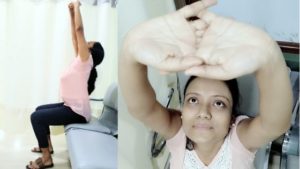
Back Stretch
- Interlock fingers together.
- Turn palms facing out and slowly lift arms overhead.
- Look up at hands.
- Feel the stretch in your fingers and shoulder.
- Hold for 20 counts
- Repeat 3 times.
Wrist Stretch
- Sit with your elbows out and palms together ( Namaste position)
- Press your palms together and slowly lower your wrists until you feel a stretch
- Hold for 20 counts.
- Repeat 3 times.
Finger Stretch
- Keep your fingers straight and together. (Right and left hand together)
- Now spread them as far apart as possible.
- Hold for 20 counts
- Repeat 3 times
Know more: Best Finger Exercise for Parkinson’s people
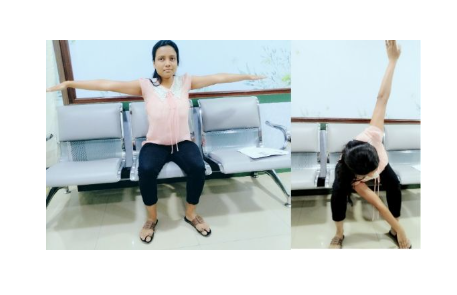
Trunk Stretch
- Sit at the edge of your chair.
- Now open your trunk, bend down, and touch your right hand to your left toe.
- Hold for 20 counts.
- Now come back to your original sitting position.
- Repeat 3 times
- Do the same on the left side 3 times.
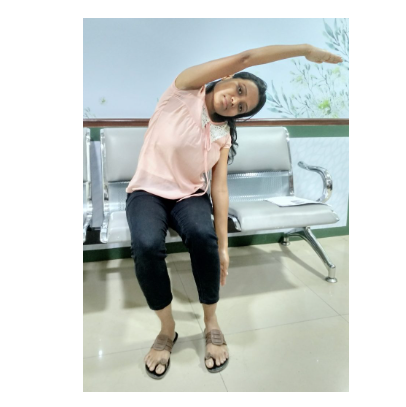
- Keep your right arm down by your side.
- Now take the left arm up over your head and close to your ear.
- Then lean your body towards the right side.
- Move your left hand with your body towards the right side & feel the stretch on the left side of your body. ( Do not lift your buttock)
- Hold for 20 counts.
- Repeat 3 times
- Repeat on the left side 3 times.
Quadriceps and Gluteus Stretch
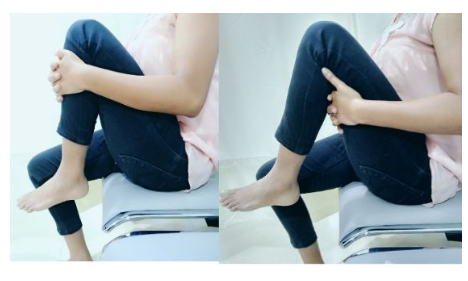
- Sit in a chair with both feet flat on the floor.
- Hold your leg below your knee and raise your right knee towards your chest as high as possible.
- Pull your knee to your chest with your hands. ( As shown in figure 1)
- Hold for 20 counts
- Repeat 3 times
- Repeat on the left leg 3 times
Note:
- Do not put pressure on your knee if you have done a knee replacement.
- Do NOT do this exercise if you have undergone knee surgery recently.
- If you have knee pain keep your hands below your knee as shown in figure 2
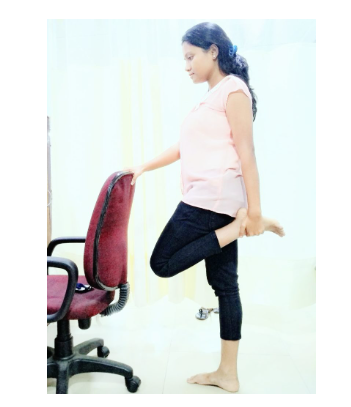
- Stand and hold the chair
- Bend right leg & hold the foot.
- Pull it towards your buttocks.
- Feel the stretch in the front of your thigh.
- Hold for 10 counts
- Repeat 3 times
- Repeat 3 times on the left leg.
DO NOT do this exercise if you have severe balance issues.
Adductor Stretch
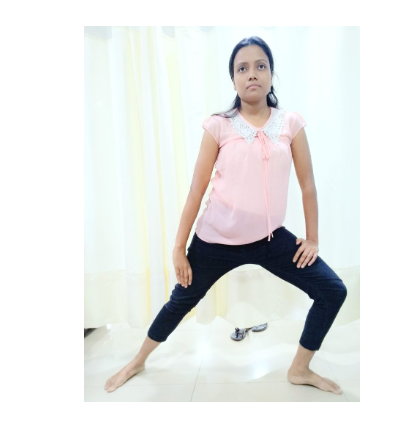
- Stand tall with your feet approximately two shoulder widths apart & a chair in front.
- Bend the right leg and shift your body to the right side.
- Keep your left leg straight. You will feel the stretch in the left inner thigh.
- Hold for 20 counts.
- Repeat 3 times.
- Repeat 3 times on the left leg.
Hamstring Stretch
- Sit in a chair and place your right leg straight out on the floor
- Keep toes pointed up & knees flat
- Keep your left leg straight. You will feel the stretch in the left inner thigh.
- Hold for 20 counts
- Repeat 3 times
- Repeat 3 times on the left leg.
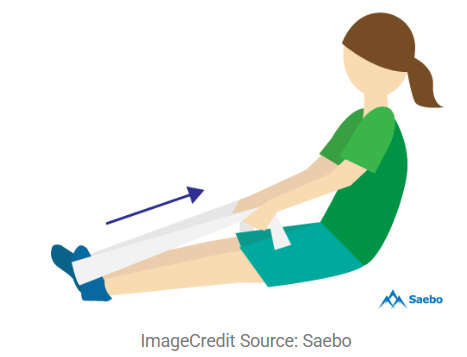
- Sit on the bed with your legs straight.
- Place a long cloth/rope below your feet and then pull the feet towards you till you feel a stretch in the back of your lower leg.
- Hold for 20 counts
- Repeat 3 times.
Leg Rotator Stretch
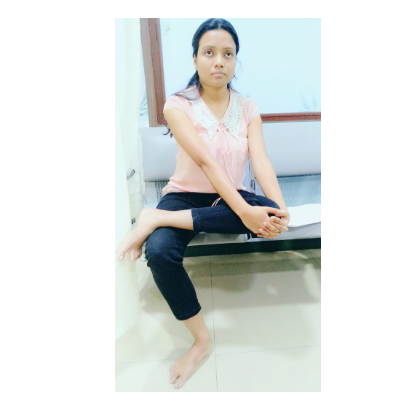
- Start in a seated position.
- Place the left foot flat on the floor and cross the right ankle over the left knee.
- Now, push your right knee downwards until a hip stretch is felt.
- Hold for 20 counts.
- Repeat 3 times.
- Repeat 3 times on the left leg.
- Note: Do not put pressure on your knee if you have done a knee replacement.
- Do not do this exercise if you have undergone knee surgery recently.
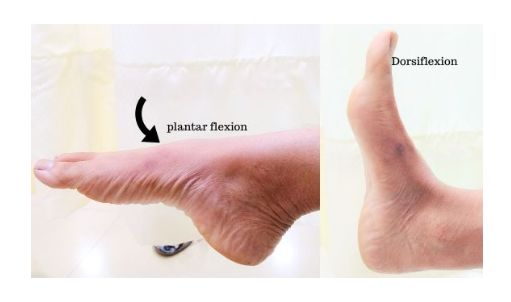
Ankle Stretch
- Raise both your legs slightly off the ground.
- Keep your knees straight
- Now move only your feet up. Point your feet and toes toward your knees
- Hold it for 20 counts
- Repeat 3 times.
- Now move only your feet down. Point your feet and toes towards the floor.
- Hold it for 20 counts.
- Repeat 3 times.
Note: Practice during the on-period time.
1. Which exercises are best for reducing rigidity in Parkinson’s disease?
Stretching exercises, large-amplitude movements, resistance training, yoga, Tai Chi, and range-of-motion exercises are among the most effective exercises for reducing muscle stiffness and improving mobility in Parkinson’s disease.
2. Can exercise reduce Parkinson’s rigidity?
Yes. Regular exercise can improve flexibility, reduce muscle stiffness, increase joint mobility, and make daily activities easier. While exercise does not cure Parkinson’s disease, it is an important part of symptom management.
3. How often should Parkinson’s patients exercise?
Most experts recommend at least 150 minutes of moderate physical activity per week, along with daily stretching and flexibility exercises. Your physiotherapist can help create an individualized exercise program.
4. Is stretching good for Parkinson’s rigidity?
Yes. Daily stretching helps improve muscle flexibility, increase range of motion, reduce stiffness, and improve posture. Stretching is most effective when combined with strengthening and aerobic exercise.
5. Should I exercise before or after taking Parkinson’s medication?
Many neurologists recommend exercising during the medication “on” period, typically 45 to 60 minutes after taking medication, when movements are easier and stiffness is reduced.
6. Can yoga help reduce muscle rigidity in Parkinson’s disease?
Yes. Gentle yoga may improve flexibility, posture, balance, breathing, and relaxation, which can help reduce the effects of rigidity and improve overall mobility.
7. Are resistance exercises safe for Parkinson’s patients?
Yes. Resistance exercises using body weight, resistance bands, or light weights are generally safe when performed under professional guidance. They help improve muscle strength, balance, and functional independence.
8. Can exercise replace medication for Parkinson’s disease?
No. Exercise is an essential part of Parkinson’s disease management, but it should complement—not replace—prescribed medications, physiotherapy, or other treatments recommended by your neurologist.